

Austin and UT have proposed amending the 1989 Brackenridge agreement so Lions Municipal Golf Course, or Muny, would pass to the City. Here's what's in it.
By Joseph Stancil, REALTOR® since 2012, Paragon Realty Group, brokered by eXp Realty, LLC (TREC broker license #603392). Texas Sales Agent License #760204.
The short answer
- What's proposed: UT Austin would transfer the 141-acre Lions Municipal Golf Course to the City "for golf course purposes." The deal would be part of amendments to the 1989 Brackenridge Development Agreement (BDA), the interlocal agreement that governs how UT may develop its land on both sides of Lake Austin Boulevard (City of Austin news release, Oct. 14, 2026; Council briefing slides, posted Nov. 13, 2026).
- What else is in the package: vacating certain City rights-of-way, changing UT's lease at Mueller, new development standards for about 190 acres of UT land, a tax increment reinvestment zone (TIRZ), and a regulating plan to be written later.
- Where it stands: nothing has been approved yet. Council gets a work-session briefing on November 17, 2026. The newest staff schedule lists Council action on December 3, 2026, not November 19 (details below).
- For nearby homeowners: the detailed rules, including the regulating plan and TIRZ terms, are not drafted yet. City staff plan to bring them back in spring 2027.
Where Muny and the Brackenridge Tract sit
In 1910, George W. Brackenridge donated about 500 acres along the Colorado River to the University of Texas. About 350 acres remain in the tract today. They hold Muny, UT student housing, the Brackenridge Field Laboratory, a youth sports complex and commercial buildings (City of Austin Brackenridge Tract page).
The tract lies west of North MoPac and is split by Lake Austin Boulevard. Muny sits east of the boulevard at 2901 Enfield Road, bordered by Enfield Road and Exposition Boulevard (Golf ATX: Lions Municipal). That puts it on the edge of Tarrytown, with Old West Austin to the east and the wider West Austin neighborhoods around it.
Muny opened in 1924. The City took over the lease in 1937 and has run the course since. In 1950, it became the first public golf course in the South to integrate. It is listed on the National Register of Historic Places, and the City says it hosts more than 75,000 rounds a year (City news release, Oct. 14, 2026).
Why this is happening now
The golf lease and the BDA are two separate agreements. The 1987 lease covers the course (141.4 acres) and the West Austin Youth Association tract (14.6 acres), and both tracts are excluded from the BDA. According to staff, the lease has been amended and extended five times, the last in May 2020, and now runs month to month (Council briefing slides). The BDA itself is now month to month as well. Either party can end it on five months' written notice (City Brackenridge Tract page). UT System's earlier planning work for the tract, including its 2009 master plan report, is posted on the UT System Brackenridge Tract page.
In 2019, the Legislature also created the Save Historic Muny District through Senate Bill 2553. Per the City, the district can accept donations or levy a utility fee, but a fee would need voter approval. Its boundaries are 35th Street, Lamar Boulevard and Lady Bird Lake.
What the amended agreement proposes
The staff briefing lists what UT gets in exchange for transferring Muny:
- the City vacates certain rights-of-way (the term sheet lists them in Exhibit B, and UT pays to relocate utilities);
- the City amends UT's Mueller lease to allow more uses, such as childcare and residential;
- the City authorizes higher development entitlements on UT's remaining Brackenridge land; and
- a private donor gives funds to UT for the sole purpose of transferring Muny to the City for golf course purposes.
UT would also replace the Brackenridge Apartments, its affordable graduate student housing on Lake Austin Boulevard. Per the term sheet, the replacement need not be inside the BDA area. City documents do not name the donor or say how much was given.
Current rules vs. proposed rules
These standards apply only to development for non-University purposes on the roughly 190 acres. Figures are from the November 17 term sheet and briefing.
| Standard | Current 1989 BDA | Proposed amendment |
|---|---|---|
| Height | Varies by tract | 65 ft along and north of Lake Austin Blvd; 105 ft south of it but not along it; compatibility rules apply north |
| Floor-to-area ratio | 0.4:1 to 0.45:1 (about 1.7M sq ft) | 0.6:1 across 190 acres (about 4.9M sq ft); no site above 5:1 without a rezoning |
| Impervious cover | 30% single-family; 60% cluster; 75% to 90% other | 75% overall; 85% per site, transferable; 45% for single-family sites |
| Building coverage | 50% | 75% per site |
| Multifamily density | 22 units per acre | No limit |
| Lady Bird Lake setback | 200 ft total | Keeps 200 ft (150 ft primary, 50 ft secondary) |
| Tributary setback | Not defined | 50 ft on each side of minor waterways |
| Trees | No regulations | Heritage tree rules blending City code and UT policy |
| Drainage and water quality | Not defined | Follow City code |
| Review process | Not the standard City process | Standard City development review |
The proposed amendment also replaces the current list of prohibited uses with a list of allowed uses for land north and south of Lake Austin Boulevard. The allowed list covers housing from single-family to multifamily, restaurants and shops, medical offices, childcare and schools, and light manufacturing south of the boulevard only.
The TIRZ and the regulating plan
Under the current BDA, the City pays for the public infrastructure that serves the property. Staff say the amendment would instead create a TIRZ "that allows UT development on the site to pay for infrastructure" (briefing slide 3). The term sheet ties the TIRZ to non-University projects in the BDA area and adds a local government corporation to manage it.
How a TIRZ works, in the City's own words: the City sets a base value for property in the zone, and tax revenue above that base is "reinvested back into the zone." The City also says, "A TIRZ does not change how much property tax anyone owes" (City of Austin TIRZ page). The legal framework is Chapter 311 of the Texas Tax Code. The zone's boundaries, length and project plan have not been published.
The regulating plan is the detailed rulebook meant to mirror the amended BDA. Staff plan to draft it, along with the TIRZ project and financing plan, after Council acts. Both would go to the Environmental and Planning Commissions and then back to Council in spring 2027.
The timeline, and the Nov. 19 question
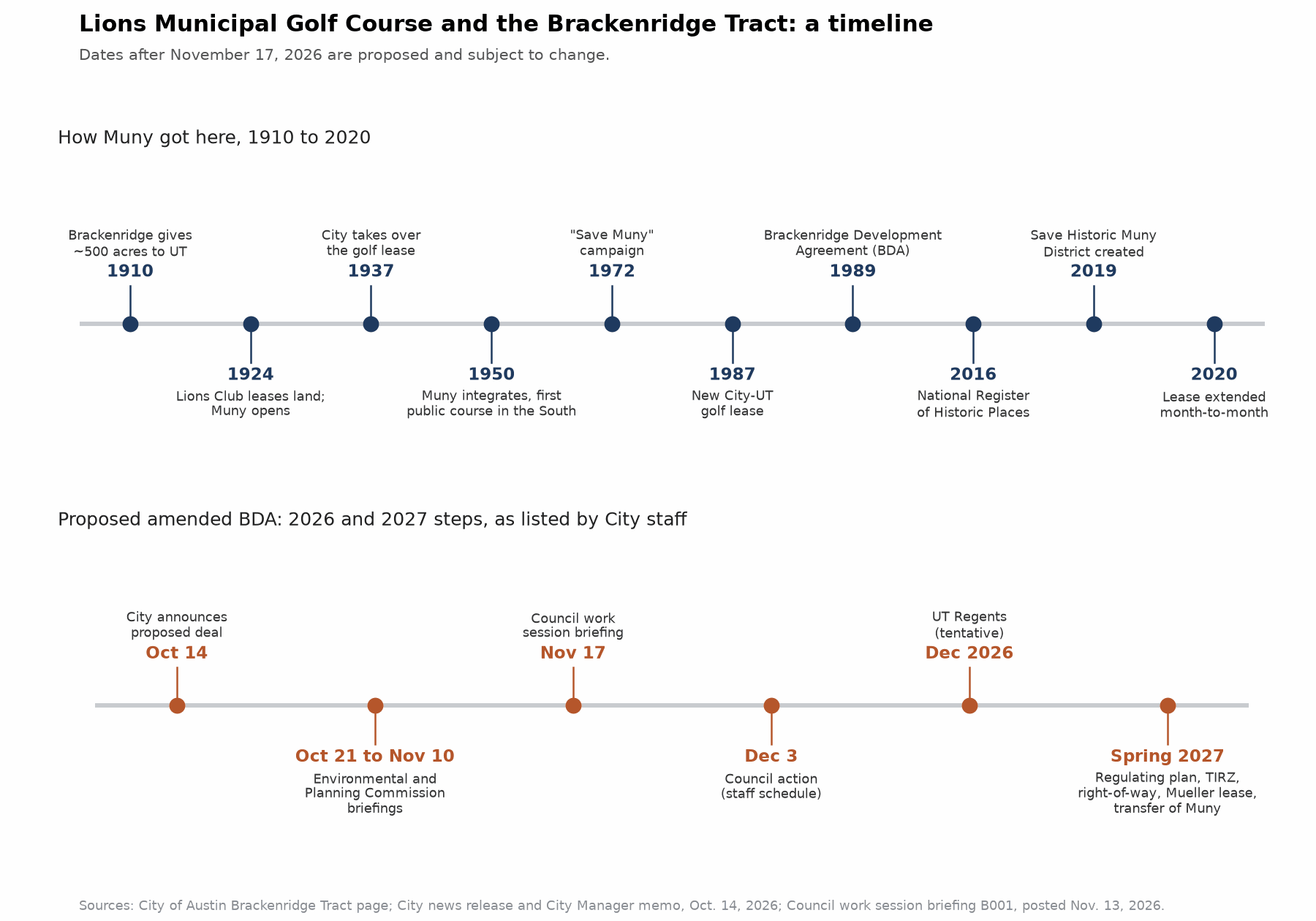
The City's October 14 release, the City Manager's October 14 memo, and the City's Brackenridge Tract page all said the amended BDA would go to Council on November 19, 2026. As of November 16:
- the posted November 19 regular meeting agenda does not include a Brackenridge or Muny item;
- the November 17 work session agenda lists it as Item B001, a briefing, with backup posted November 10 and 13; and
- the briefing's schedule slide lists "Austin City Council: December 3, 2026" and the UT Board of Regents "tentatively December 2026."
The December 3 agenda had not been posted when we checked. Agendas can change, so confirm the date on the City's Council meeting information center, where agendas and speaker sign-up details are posted.
What it means for West Austin and Tarrytown homeowners
City documents settle some questions and leave others open.
What the proposal would settle:
- Muny would be City-owned and used for golf course purposes, not part of UT's redevelopment land.
- New standards for UT's non-University projects would include a 65-foot cap measured from Lake Austin Boulevard, compatibility rules north of the boulevard, the 200-foot lake setback, tree rules and standard City review.
What is still open:
- the regulating plan, which will turn the standards into site-by-site rules;
- the TIRZ boundaries, term and project list;
- which rights-of-way are vacated, and how traffic and utilities are handled; and
- when development would actually start. City documents give no construction schedule.
If you own, or are buying, a home near the tract:
- Know the boundary. The Council posting describes the BDA area as generally bounded by Lady Bird Lake to the south and west, Enfield Road and 8th Street to the north, and Veterans Drive and Hearn Street to the east.
- Read the source documents. The term sheet and the Exhibit A-2 use list for land north of Lake Austin Boulevard are the most useful to a nearby owner.
- Follow the spring 2027 steps. The regulating plan will go through public commission meetings before Council votes.
- Ask about disclosures and plans in writing. A buyer can ask a seller and the seller's agent what they know about nearby planned development. Check the City's development review records for specific addresses.
We don't predict how any of this affects home values. For current sales data, see our Austin housing market report for October 2026.
Frequently asked questions
Is Lions Municipal Golf Course being sold or closed?
No closure is proposed. Under the City and UT proposal, UT would transfer Muny to the City of Austin for golf course purposes. In exchange, the City would vacate certain rights-of-way, amend UT's Mueller lease and allow more development on other UT Brackenridge land, while a private donor funds UT. None of this is final. Council and the UT Board of Regents must each approve, and the transfer itself is listed among spring 2027 steps.
When will Austin City Council vote on the Muny agreement?
The latest City staff schedule lists December 3, 2026. Earlier City documents said November 19, but the posted November 19 agenda does not include the item. Council gets a work-session briefing on November 17. The UT Board of Regents is tentatively set for December 2026. Check the City's Council meeting information center for the current agenda before planning to attend or speak, because posted dates can change.
What is the Brackenridge Development Agreement in Austin?
It is a 1989 interlocal agreement between Austin and UT that sets development rules for UT's Brackenridge land. It settled a dispute over who regulates UT land used for non-University purposes. It has been amended several times and now runs month to month. Either side can end it with five months' written notice. The golf course lease is a separate agreement, which is why the Muny transfer needs both documents addressed.
Will a Brackenridge TIRZ raise my property taxes?
The City says a TIRZ does not change how much property tax anyone owes. A TIRZ sets a base value for property inside the zone and sends tax revenue above that base to a fund for improvements within the zone. Here, staff say it would pay for infrastructure serving UT's development. The zone's boundaries and terms have not been published. Your own taxes still depend on your appraisal, exemptions and each taxing unit's rate.
How tall could buildings be on the Brackenridge Tract?
Under the proposed amendment, no building could exceed 65 feet measured from Lake Austin Boulevard. Buildings along and north of the boulevard would be capped at 65 feet. Buildings south of it but not along it could reach 105 feet. Compatibility rules would apply north of the boulevard, and the 200-foot setback from Lady Bird Lake stays. These terms apply to non-University development and could still change before approval.
Joseph Stancil, TX License #760204, Paragon Realty Group, brokered by eXp Realty, LLC, TX Broker License #603392. General information, not legal, tax or financial advice. Details are from City of Austin documents as published and checked on November 16, 2026: the Brackenridge Tract page, the October 14, 2026 news release and City Manager memo, and the November 17, 2026 work session briefing, term sheet and agendas posted November 10 and 13, 2026. Proposed terms and dates may change before any approval. Paragon Realty Group is not affiliated with the City of Austin, The University of Texas at Austin or the UT System, and this article takes no position on the proposal. Illustrations are AI-generated, not photos of the actual course or homes.

Joseph Stancil
Founder & Supervising Agent | Paragon Realty Group
Joseph Stancil brings over 13 years of Austin real estate expertise to every article in The Paragon Chronicle. His market analysis draws on proprietary data, direct transaction experience, and deep relationships throughout Austin's luxury communities.