
At 2026 rates, a homestead exemption trims about $2,500 a year off a $550,000 Austin home's tax bill and about $1,360 in Round Rock. Here's the math and how to file.
By Joseph Stancil, REALTOR® since 2012, Paragon Realty Group, brokered by eXp Realty, LLC (TREC broker license #603392). Texas Sales Agent License #760204.
The savings in dollars
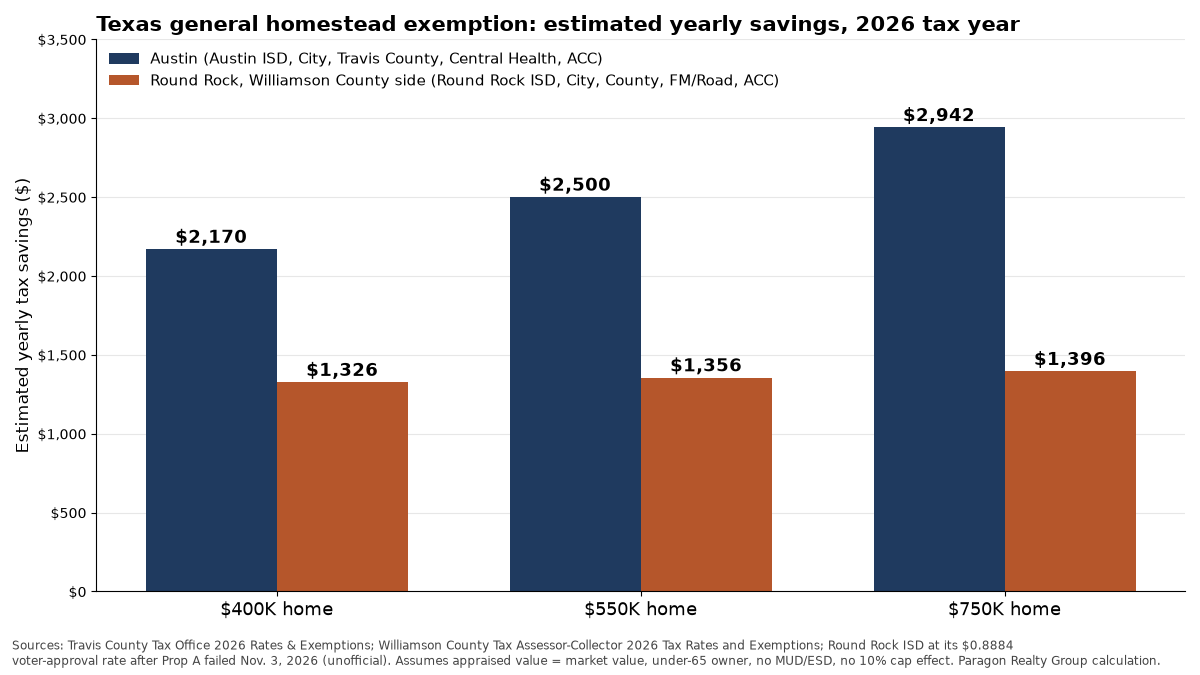
Texas has no state property tax, so every dollar of homestead relief comes from the local units that tax your home: the school district, the county, the city and any special districts. Each one removes a slice of value before applying its rate. Adding up those slices for a home in the City of Austin and Austin ISD, and for a home in Round Rock on the Williamson County side, gives these 2026 estimates:
| Home value | Austin (Travis County) yearly savings | Round Rock (Williamson County) yearly savings |
|---|---|---|
| $400,000 | about $2,170 | about $1,326 |
| $550,000 | about $2,500 | about $1,356 |
| $750,000 | about $2,942 | about $1,396 |
These are Paragon Realty Group calculations built from the Travis County Tax Office 2026 rates and exemptions list and the Williamson County Tax Assessor-Collector's 2026 Tax Rates and Exemptions by Jurisdiction list. They assume an owner under 65, an appraised value equal to market value, and no municipal utility district, emergency services district or public improvement district on the bill. Your own number depends on the units that tax your parcel, so confirm it with your appraisal district.
How the math works for one Austin home
The school district piece is a flat dollar amount. Since voters approved Senate Bill 4's constitutional amendment in November 2025, Tax Code §11.13(b) requires every Texas school district to exempt $140,000 of a homestead's appraised value (Texas Comptroller, Property Tax Exemptions; Texas Tax Code Chapter 11). The Comptroller's own illustration: a $300,000 home pays school tax as if it were worth $160,000.
Cities, counties and special districts may add a local-option exemption of up to 20% of appraised value, with a $5,000 floor (§11.13(n)). Austin, Travis County and Central Health all grant the full 20%. Austin Community College grants 1% with the $5,000 floor. Here is the $550,000 example, line by line:
| Taxing unit | 2026 rate per $100 | Homestead exemption | Value exempted | Yearly savings |
|---|---|---|---|---|
| Austin ISD | $0.9184 | $140,000 (state-mandated) | $140,000 | $1,285.76 |
| City of Austin | $0.579948 | 20% | $110,000 | $637.94 |
| Travis County | $0.38621 | 20% | $110,000 | $424.83 |
| Central Health | $0.132863 | 20% | $110,000 | $146.15 |
| Austin Community College | $0.103643 | 1%, $5,000 minimum | $5,500 | $5.70 |
| Total | $2.121064 | about $2,500 |
The formula for each row is the exempted value times the rate, divided by 100. Without any exemption, those five units would bill about $11,666 on a $550,000 value. With the exemption, the bill is about $9,165, a cut of roughly 21%.
Why Williamson County numbers come out smaller
The same $140,000 school exemption applies in Round Rock ISD, but the other units are less generous. On the Williamson County list, the county exempts 5% with a $5,000 minimum, the county's farm-to-market and road fund exempts $3,000, the City of Round Rock offers no general homestead exemption, and Austin Community College exempts 1% with a $5,000 minimum. Because most of the relief is a fixed school-district amount, the savings barely move as home values rise. The Austin percentage exemptions grow with value.
One wrinkle for 2026: Round Rock ISD adopted a $0.9484 rate that needed voter approval, and Proposition A failed on November 3, 2026, by 52.3% to 47.7% in unofficial results (Round Rock ISD). The district's rate then defaults to its voter-approval rate, estimated at $0.8884 (TTARA, estimated tax year 2026 school district rates). The Round Rock figures above use $0.8884, so check the final rate on your 2026 statement. Inside Georgetown city limits, the City of Georgetown adds a 5% exemption, so savings there land between these two examples. Our Georgetown housing market report and Round Rock area page have more local context.
Who qualifies, and the January 1 rule
A residence homestead exemption requires that you own the home and live in it as your principal residence. You may claim only one homestead. The general rule in Tax Code §11.42(a) is that eligibility for a tax year is set by your situation on January 1.
There is a significant exception for buyers. Under §11.42(f), a person who acquires a home after January 1 may receive the general homestead exemption for the part of the year they own it, as long as the previous owner did not receive the same exemption that year. The Williamson Central Appraisal District says this applies to homes bought on or after January 1, 2022. The Travis Central Appraisal District describes it as available "in limited circumstances," which mostly means new construction or homes the prior owner rented out or held as a second home. If the seller already had a homestead exemption for the year, it stays on that year's bill, and yours starts the following January 1.
Filing Form 50-114 step by step
- Get the form. The application is Comptroller Form 50-114, Residence Homestead Exemption Application. Both appraisal districts also take applications online.
- Match your ID to the property. Section 11.43(n) bars approval unless the address on your Texas driver's license or state ID matches the home. Update your license first if you just moved.
- File with the appraisal district, not the tax office. In Travis County that is TCAD, by mail, online or at 850 East Anderson Lane. In Williamson County, look up your parcel on the WCAD site and click the HS Exemption link.
- Pay nothing and file once. Neither district charges a fee, and §11.43(c) says an allowed homestead exemption need not be claimed again in later years.
- Watch for the decision. TCAD says it acts on applications within 90 days.
Deadlines and late applications
The Comptroller's homestead overview sets the usual deadline at April 30 for the tax year you're claiming. Travis County's homestead page gives the same January 1 to April 30 window. Missing it is fixable: §11.431(a) requires the chief appraiser to accept a late homestead application filed up to two years after the delinquency date for that year's taxes. If the bill was already paid, the tax office should send a corrected statement and refund the difference.
The 10% cap on appraised value
The exemption's second payoff starts a year later. Once a home qualifies, Tax Code §23.23 limits how much the appraisal district may raise its appraised value for a tax year to 10% over the prior year's appraised value, plus the value of any new improvements (Texas Tax Code Chapter 23). The cap takes effect on January 1 of the tax year after the first year you qualify, and it ends when no qualifying owner, spouse or surviving spouse holds the exemption. Your market value can still climb faster than 10%. The cap applies only to the value the taxing units use.
Extra relief at 65 or with a disability
Owners 65 or older, or disabled, get another $60,000 off school taxes under §11.13(c). Local units may add their own amounts. On the 2026 Travis list, Austin ISD adds $25,000 for over-65 owners, the City of Austin $204,000, Travis County $145,269, Central Health $197,000 and ACC $75,000. On the $550,000 Austin example, those amounts trim about $2,864 more, for a combined estimate near $5,364.
Two more protections matter:
- The school tax ceiling. Section 11.26 freezes the school district's tax on the home at the year you qualify. It can rise only if you add improvements such as a pool or garage.
- Local ceilings. The City of Austin, Travis County, Central Health and ACC all show a tax ceiling on the Travis list, as do Williamson County and ACC on the Williamson list.
The over-65 exemption is effective for the full tax year in which you turn 65 (§11.42(c)). Under §11.43(m), a homeowner who already has a general homestead exemption gets it the next year without a new application.

A closing-day checklist for new buyers
- Read the seller's current bill. A seller's homestead, over-65 ceiling or 10% cap can make the current bill look lighter than yours will be. The tax-proration line on your closing statement uses those numbers, so ask your lender to estimate escrow from the full rates.
- Ask whether the seller had a homestead this year. If not, you may qualify for the rest of this year under §11.42(f).
- Update your driver's license address, then file Form 50-114 soon after you move in.
- Calendar April 30 if you closed late in the year and want to be safe for next year's bill.
- Budget for MUD, ESD or PID charges if the subdivision has them. Many of those districts give no general homestead exemption.
For more on planning the buying side, see when Austin buyers should lock a mortgage rate and the Austin housing market report. Lake Travis buyers can compare tax bills in our Steiner Ranch guide. Questions about a specific home? Reach out to Paragon Realty Group.
Frequently asked questions
How much does the Texas homestead exemption save each year?
At 2026 rates, the general homestead exemption cuts roughly $2,170 to $2,940 a year in Austin and $1,330 to $1,400 in Round Rock. The core is the $140,000 school district exemption, which every Texas district must grant. Austin, Travis County and Central Health each add a 20% exemption, which is why Austin savings rise with home value. The examples assume an owner under 65 and no utility district taxes. Confirm with your appraisal district.
What is the school district homestead exemption amount for 2026?
The state-mandated school district homestead exemption is $140,000 for the 2026 tax year. Texas voters approved raising it from $100,000 in November 2025, and Tax Code §11.13(b) now sets $140,000. Owners 65 or older, or disabled, receive an additional $60,000 from school taxes under §11.13(c). Some districts add more. Austin ISD lists an extra $25,000 for over-65 owners on the Travis County 2026 rates list.
Can I file for homestead exemption the year I buy?
Yes, in some cases. Tax Code §11.42(f) lets a buyer who acquires a home after January 1 receive the general exemption for the part of the year they own it. The catch is that the previous owner must not have received the same exemption for that year. If the seller lived in the home and claimed it, your exemption starts the next January 1. Either way, file Form 50-114 soon after you move in.
Where do I file a homestead exemption in Travis County?
File with the Travis Central Appraisal District, not the Travis County Tax Office. TCAD accepts Form 50-114 by mail, online or in person at 850 East Anderson Lane in Austin. Include a copy of your Texas driver's license or state ID showing the property address. There is no fee, and you do not need to reapply each year. Williamson County homeowners file with WCAD through the HS Exemption link on their property record.
What happens if I miss the April 30 homestead deadline?
You can usually still file. Under Tax Code §11.431, the appraisal district must accept a late homestead application filed up to two years after the delinquency date for that year's taxes. Taxes are generally delinquent February 1 of the following year. If you already paid the full bill, the tax office will send a corrected statement and refund the difference. Check the dates with your appraisal district before relying on the late window.
Joseph Stancil, TX License #760204, Paragon Realty Group, brokered by eXp Realty, LLC, TX Broker License #603392. General information, not legal, tax or financial advice. Exemption amounts and rates are from the Texas Comptroller, Texas Tax Code Chapters 11 and 23, the Travis County Tax Office 2026 Rates and Exemptions list and the Williamson County Tax Assessor-Collector 2026 Tax Rates and Exemptions list, checked November 17, 2026. The Round Rock ISD rate reflects unofficial November 3, 2026 election results. Your actual savings depend on your parcel's taxing units, appraised value and eligibility, so confirm with your appraisal district or tax office. Paragon Realty Group is not affiliated with the Texas Comptroller, any appraisal district, tax office, school district or local government. Illustrations are AI-generated, not photos of actual homes.

Joseph Stancil
Founder & Supervising Agent | Paragon Realty Group
Joseph Stancil, first licensed in real estate in 2012 and in Texas since 2021, writes every article in The Paragon Chronicle. His market analysis draws on proprietary data, direct transaction experience, and deep relationships throughout Austin's luxury communities.