

A mortgage rate lock holds your interest rate from loan offer to closing, as long as you close on time. Here is how locks, float-downs and extensions work for Austin buyers after October's hot CPI.
By Joseph Stancil, REALTOR® since 2012, Paragon Realty Group, brokered by eXp Realty, LLC (TREC broker license #603392). Texas Sales Agent License #760204.
The short answer
- What a lock is: the Consumer Financial Protection Bureau says a rate lock "means that your interest rate won't change between the offer and closing, as long as you close within the specified time frame and there are no changes to your application" (CFPB).
- Should you lock now? If you have an accepted contract and a closing date, locking removes the risk that rates rise before you close. Floating only makes sense if you can absorb a higher payment should rates move against you. Nobody, including your lender, knows which way rates go next.
- How long: the CFPB says locks are "typically available for 30, 45, or 60 days, and sometimes longer." Match the lock to your contract's closing date plus a cushion.
- What it costs: pricing varies by lender. Longer locks and extensions can cost more, and the Loan Estimate does not show those costs, so you have to ask.
- Float-down: some lenders offer a one-time option to move to a lower rate if rates fall during your lock. Terms vary, and it may carry a fee.
Every rate in this article is a published market average, not an offer. Get a Loan Estimate from your lender for your actual rate, points and lock terms.
Where mortgage rates stand after the October CPI
The Bureau of Labor Statistics reported on November 10 that the Consumer Price Index "increased 0.4 percent on a seasonally adjusted basis in October after rising 0.6 percent in September," with core CPI (excluding food and energy) up 0.3% (BLS). BLS did not publish a standard 12-month change for October because October 2025 data were not collected during the government shutdown.
Markets read the report as a reason for the Federal Reserve to keep tightening. CNBC reported that, according to CME Group's FedWatch tool, traders were fully pricing in a quarter-point increase at the Fed's December 8–9 meeting, with the odds of a half-point move at 13.6%. The meeting dates are on the Federal Reserve's FOMC calendar.
Mortgage rates reacted the same day. The Mortgage News Daily index for the average top-tier 30-year fixed rate rose 0.12 percentage points to 7.30% on November 10, its largest one-day increase in over a month, though still below the 7.6%-plus levels of early October (Mortgage News Daily).
Freddie Mac's weekly survey, released today, shows a calmer picture. The 30-year fixed-rate mortgage averaged 7.11% as of November 12, 2026, down from 7.18% the week before and the fourth straight weekly decline; a year ago it averaged 6.24%. The 15-year fixed averaged 6.45%, down from 6.57% (Freddie Mac PMMS). The two figures are not in conflict. Freddie Mac says PMMS results "are an average of loan rates offered the prior Thursday through Wednesday," so this week's average blends days before and after the CPI release, while the daily index captures the post-CPI jump. The chart below shows the weekly series over the past two years (FRED, MORTGAGE30US).
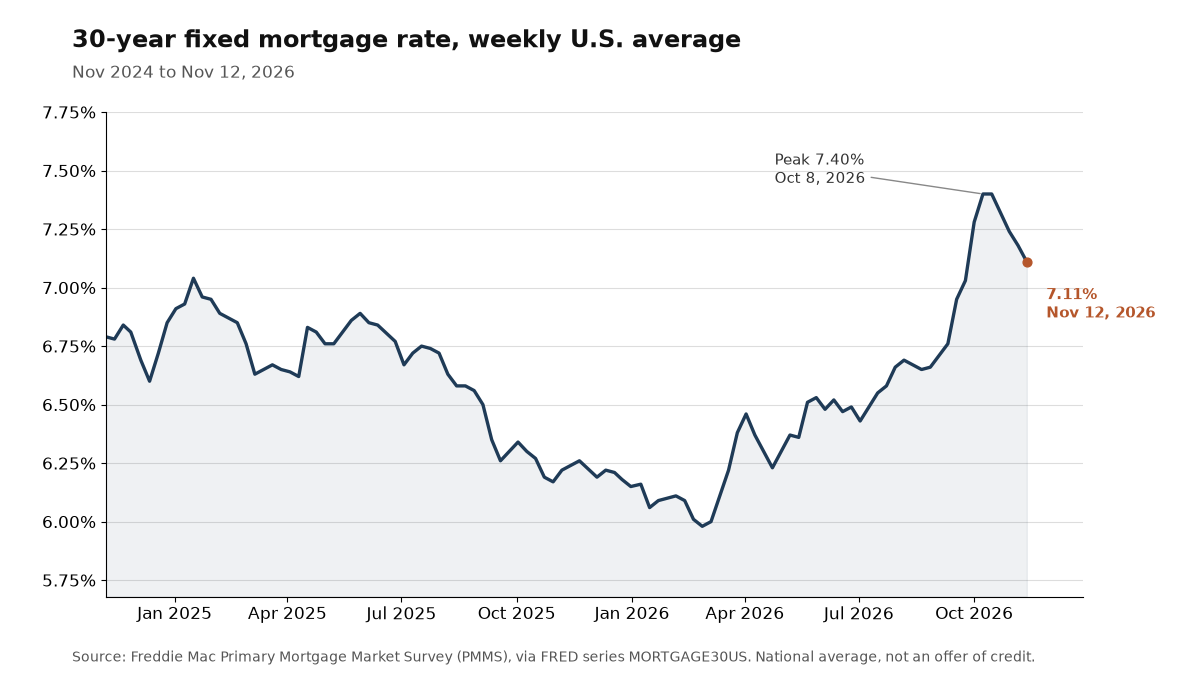
Daily indexes like Mortgage News Daily move faster than the weekly Freddie Mac survey, which is why the two numbers rarely match on a given day. Neither is the rate on your loan. Your rate depends on your credit, down payment, loan type, points and the day you lock.
What a 0.25-point move does to an Austin payment
Unlock MLS reported an October median sales price of $404,802 for the Austin-Round Rock-San Marcos metro (down 6.9% from a year earlier) and $550,000 for the City of Austin (flat), with 2,114 metro sales, down 11.4% (Unlock MLS). The table below shows monthly principal and interest on a 30-year fixed loan at loan amounts near those price points.
| Loan amount | 6.75% | 7.00% | 7.25% | 7.50% |
|---|---|---|---|---|
| $325,000 (about 80% of the metro median) | $2,108 | $2,162 | $2,217 | $2,272 |
| $440,000 (80% of the City of Austin median) | $2,854 | $2,927 | $3,002 | $3,077 |
| $550,000 | $3,567 | $3,659 | $3,752 | $3,846 |
| $1,000,000 | $6,486 | $6,653 | $6,822 | $6,992 |
Illustrative principal and interest only, calculated on a standard 30-year amortization. Not a quote or an offer of credit; excludes taxes, insurance, HOA dues and mortgage insurance.
Each quarter-point step adds about $55 a month on a $325,000 loan, about $93 on $550,000 and about $169 on $1,000,000. Over a year, a quarter point on a $550,000 loan is roughly $1,100 in payments. That is the risk a lock removes, and the number to weigh against what a longer lock or float-down costs. To run your own numbers, including estimated property taxes and insurance, use the Paragon mortgage calculator.
Lock or float: how to decide
The CFPB is direct about the trade-off: a lock "may be expensive to extend if your transaction needs more time," and it "may lock you out of a lower interest rate if rates fall after you get your loan offer" (CFPB). Questions that usually settle it:
- Do you have a signed contract and a closing date? Without one, there is usually nothing to lock against; ask your lender whether it will lock before you have a property under contract, since policies vary.
- Can your budget handle a higher rate? Use the table above. If a quarter or half point higher would push the payment past what you're comfortable with, the case for locking is strong.
- What is on the calendar before closing? Rates often move on inflation and jobs reports and Fed meetings. The next FOMC decision is December 9. Floating through those dates is a bet on the outcome.
- What does the lender charge for a longer lock, an extension or a float-down? Get it in writing so you can compare against the payment math.
Austin's market gives buyers more room than it did a few years ago. Unlock MLS put metro inventory at 6.2 months in October, 0.4 months more than a year earlier. That can mean longer negotiations and inspection periods, so plan your lock length around the timeline you actually agree to, not the fastest case.
How long to lock, and what extensions cost
Start from the closing date in your contract and work backward. A 30-day contract on a resale home usually fits a 30- or 45-day lock. New construction with an uncertain completion date may need a longer lock or a builder program; ask the builder's lender and an outside lender to put each option in writing.
The CFPB notes that your Loan Estimate does not show how much you are paying for the specific lock period, whether a different period would cost more or less, or what an extension would cost. Ask your lender these questions, which the CFPB recommends:
- "What rate lock time frame does this Loan Estimate provide?"
- "Is a shorter or longer rate lock available, and at what cost?"
- "What if my closing is delayed and the rate lock expires?"
- "If I lock my rate, are there any conditions under which my rate could still change?"
- "If I lock my rate, and interest rates go down, what happens?"
A locked rate can still change if your application changes. The CFPB lists changing the loan type or down payment, an appraisal that comes in higher or lower than expected, a credit-score change (for example from a new loan or a missed payment) and income the lender cannot document. Avoid new credit, large unexplained deposits and job changes until you close.

Float-down options
Freddie Mac's homebuyer site explains that if rates drop after you lock, "you usually stay locked in at the higher rate," but "some lenders may offer a 'float-down' option, which lets you take advantage of a lower rate if one becomes available during your lock period," and that terms and availability vary (Freddie Mac My Home).
Before paying for one, ask: how far do rates have to fall before it can be used, whether you can use it once or more than once, when in the lock period it can be exercised, and what it costs upfront or at closing. Compare that cost with the payment difference in the table above. A float-down that only triggers after a half-point drop protects you less than one that triggers at a quarter point.
A buyer's lock checklist
- Get Loan Estimates from more than one lender on the same day, so the rates are comparable.
- Confirm on page 1 of each Loan Estimate whether the rate is locked and when the lock expires.
- Match the lock to your contract closing date, plus a cushion for appraisal, title and survey.
- Ask for lock-extension and float-down pricing in writing.
- Keep your credit, income and down payment unchanged until closing.
- Tell your agent and lender right away if anything could delay closing, so an extension can be planned rather than rushed.
For help building a realistic contract timeline, see our buyer services, the Austin area guide, and what buyers look for in Austin homes in 2026, or contact Paragon Realty Group.
Frequently asked questions
What is a mortgage rate lock?
A rate lock is a lender's commitment that your interest rate won't change between the loan offer and closing, provided you close within the lock period and your application doesn't change. Locks are commonly 30, 45 or 60 days. Check page 1 of your Loan Estimate to see whether your rate is locked and when the lock expires.
When should I lock my mortgage rate?
Most buyers lock once they have an accepted contract and a closing date, because that is when the lender can tie the rate to a specific loan and property. Lock earlier in the process if a higher payment would strain your budget. Floating is a bet on rates falling, and no one can reliably predict short-term rate moves.
Does it cost money to lock a mortgage rate?
It depends on the lender. A standard lock may be included in your pricing, while longer locks, extensions and float-down options often cost more. The CFPB notes the Loan Estimate does not show what you're paying for the lock period or what an extension would cost, so ask your lender to put those figures in writing.
What happens if my rate lock expires before closing?
If closing slips past the lock expiration, you'll usually need to pay for an extension or relock at current market pricing, which could be higher. Tell your lender as soon as a delay looks possible. Building a cushion of a week or two into the lock period, beyond the contract closing date, helps avoid paying for an extension.
What is a float-down option?
A float-down lets you move to a lower rate if market rates fall during your lock period. Not all lenders offer one, and terms vary: some require rates to drop by a set amount, allow only one use, or charge a fee. Compare the cost with the monthly payment difference a lower rate would make before you pay for the option.
Are Austin mortgage rates different from national averages?
The Freddie Mac survey and Mortgage News Daily index are national averages. Rates offered in Austin follow the same national markets, but your rate depends on credit score, down payment, loan type, points and lock length. A Loan Estimate from your lender is the only reliable figure for your purchase.
Joseph Stancil, TX License #760204, Paragon Realty Group, brokered by eXp Realty, LLC, TX Broker License #603392. General information, not financial or lending advice. Rates cited are published market averages as of the dates shown, not offers of credit; get a Loan Estimate from your lender. Market data from Unlock MLS as published November 11, 2026. Chart data from Freddie Mac's Primary Mortgage Market Survey. Illustrations are AI-generated, not photos of specific properties.

Joseph Stancil
Founder & Supervising Agent | Paragon Realty Group
Joseph Stancil brings over 13 years of Austin real estate expertise to every article in The Paragon Chronicle. His market analysis draws on proprietary data, direct transaction experience, and deep relationships throughout Austin's luxury communities.