
Texas new-home sales fell for a fifth straight month in October, and builders say incentives will stay large into 2027. Finished homes in Williamson County carry the most pressure to sell.
By Joseph Stancil, REALTOR® since 2012, Paragon Realty Group, brokered by eXp Realty, LLC (TREC broker license #603392). Texas Sales Agent License #760204.
The October numbers arrived the week of Thanksgiving, and they point the same way as the four months before them. Fewer new homes closed, fewer went under contract and the average price slipped again. For anyone shopping new construction in Georgetown, Leander, Hutto, Liberty Hill or Round Rock, the practical question is what that softness means at the sales office. This article walks through the data, what builders themselves are saying about 2027, and the paperwork that decides whether an offer is worth what the flyer says. For the specific offers running in one master-planned community right now, see our Wolf Ranch builder incentives page.
Five months of falling Texas new-home sales, by the numbers
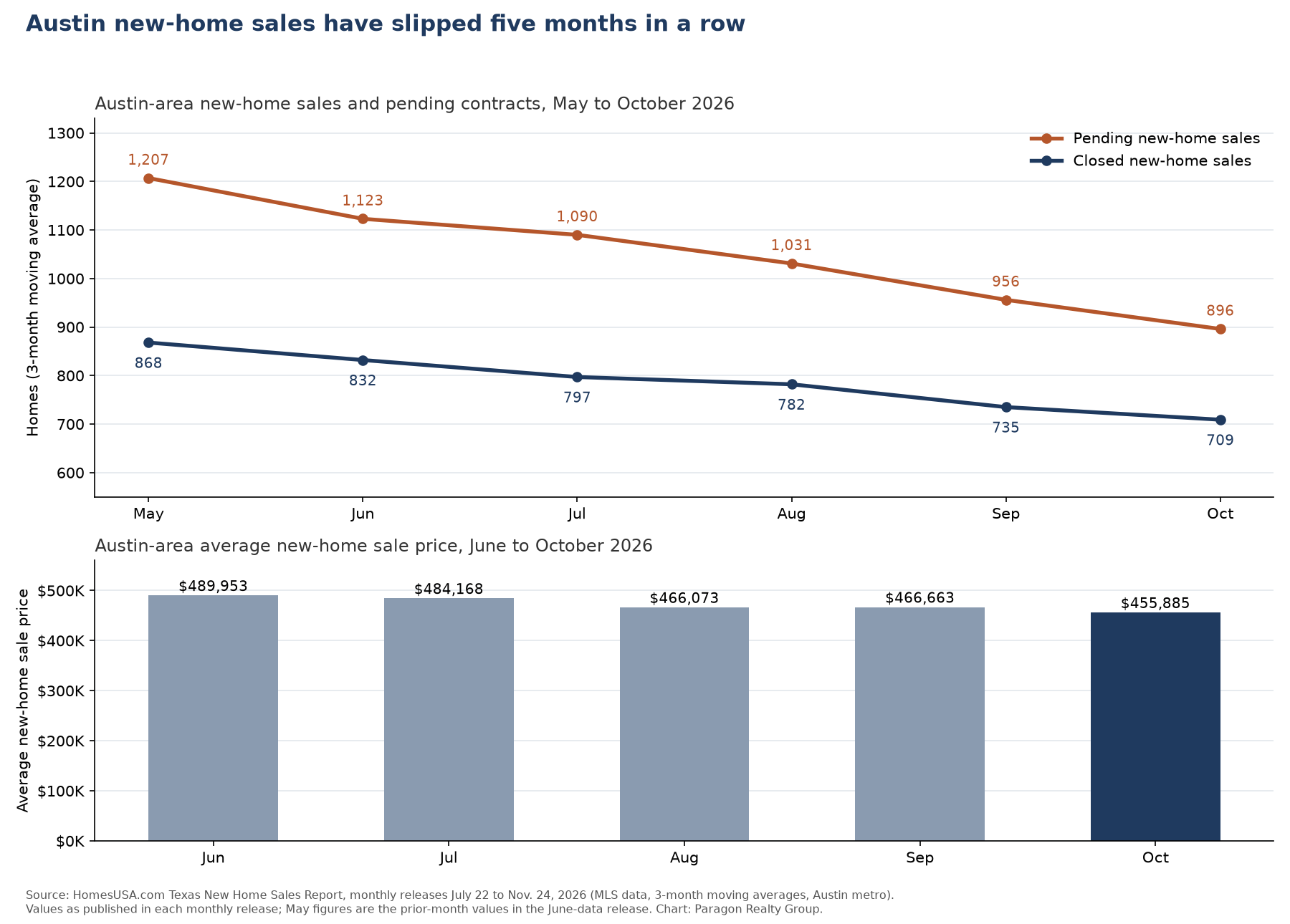
The HomesUSA.com Texas New Home Sales Report, released on November 24, 2026, uses MLS data and three-month moving averages for the Austin, Dallas-Fort Worth, Houston and San Antonio metros (HomesUSA.com via GlobeNewswire). Statewide, October closings averaged 5,018, down 3.9% from September and 7.6% below October 2025. It was the fifth monthly decline in a row and the smallest total of the year. Pending sales fell 6.3% to 5,119, also a fifth straight drop and 12.8% below a year earlier. The statewide average new-home price was $415,948, against $428,309 a year before.
The Austin metro, which includes Williamson County, moved the same direction with smaller steps.
| Austin metro new homes | September 2026 | October 2026 | Change |
|---|---|---|---|
| Closed sales | 735 | 709 | -3.5% |
| Pending sales | 956 | 896 | -6.3% |
| Average sale price | $466,663 | $455,885 | -2.3% |
| Average days on market | 97 | 94 | 3 days faster |
| Active listings | 6,067 | 6,052 | -15 homes |
| Sales-to-list price ratio | 97.89% | 98.13% | +0.24 points |
Austin was the only one of the four metros where days on market fell in October. HomesUSA CEO Ben Caballero said pending sales peaked in April and that Austin and San Antonio were "doing slightly better" than Dallas-Fort Worth and Houston. Read the price ratio with care. It compares the closing price to the list price, so a rate buydown or closing-cost credit paid outside the price may not show up in it at all.
Going back to late spring, the drift is steady rather than sudden. Austin pending sales fell from 1,207 in May to 896 in October, and the average new-home price fell from $489,953 in June to $455,885 in October, as reported in each month's release (HomesUSA.com, July 22; HomesUSA.com, October 22).
Why the national report pointed the other way
One day after the Texas report, the Census Bureau and HUD said national new-home sales jumped 14.2% in October to a seasonally adjusted annual rate of 701,000, with the South up 36.2% (U.S. Census Bureau, November 25, 2026). Those headlines look like a contradiction. They are mostly a difference in method.
The Census survey counts a home as sold when a deposit is taken or a contract is signed, using a sample of builders, and its monthly changes carry wide error bands. October's national gain had a 90% confidence interval of plus or minus 22.6%, and the South's was plus or minus 34.8%, so the Bureau could not say with confidence that sales rose at all. The Texas report counts closings and pendings entered in the MLS and smooths them over three months. Both reports agree on supply. Census counted 470,000 new homes for sale nationally, 8.0 months at the current pace, with 112,000 of them already finished. The National Association of Home Builders put combined new and existing supply at 5.4 months (NAHB, November 25, 2026).
What builders themselves expect for 2027
Builder sentiment tells the incentive story more directly than sales counts do. The NAHB/Wells Fargo Housing Market Index fell four points to 25 in November, its weakest reading since April 2012 (NAHB, November 17, 2026). Buyer traffic scored 16. In the same survey, 46% of builders reported cutting prices, up from 43% in October and 38% in September, and the average cut held at 6%. Sixty-eight percent offered some form of sales incentive. The South's three-month average fell to 27.
Public builders are saying the same thing in their filings. D.R. Horton, based in Arlington, closed its fiscal year on September 30 and told investors, "We expect incentives to remain elevated in fiscal 2027, the extent of which will depend on market conditions throughout the year" (D.R. Horton earnings release, SEC filing, October 29, 2026). On the earnings call, management said incentives were running "well above our historical norm" and that the company sets rate buydowns, included features and price community by community (D.R. Horton fourth-quarter call transcript). Its home sales gross margin fell to 20.2% for the year from 21.5%. That is the cost of incentives showing up in a public company's books.
Where a Williamson County buyer has the most room
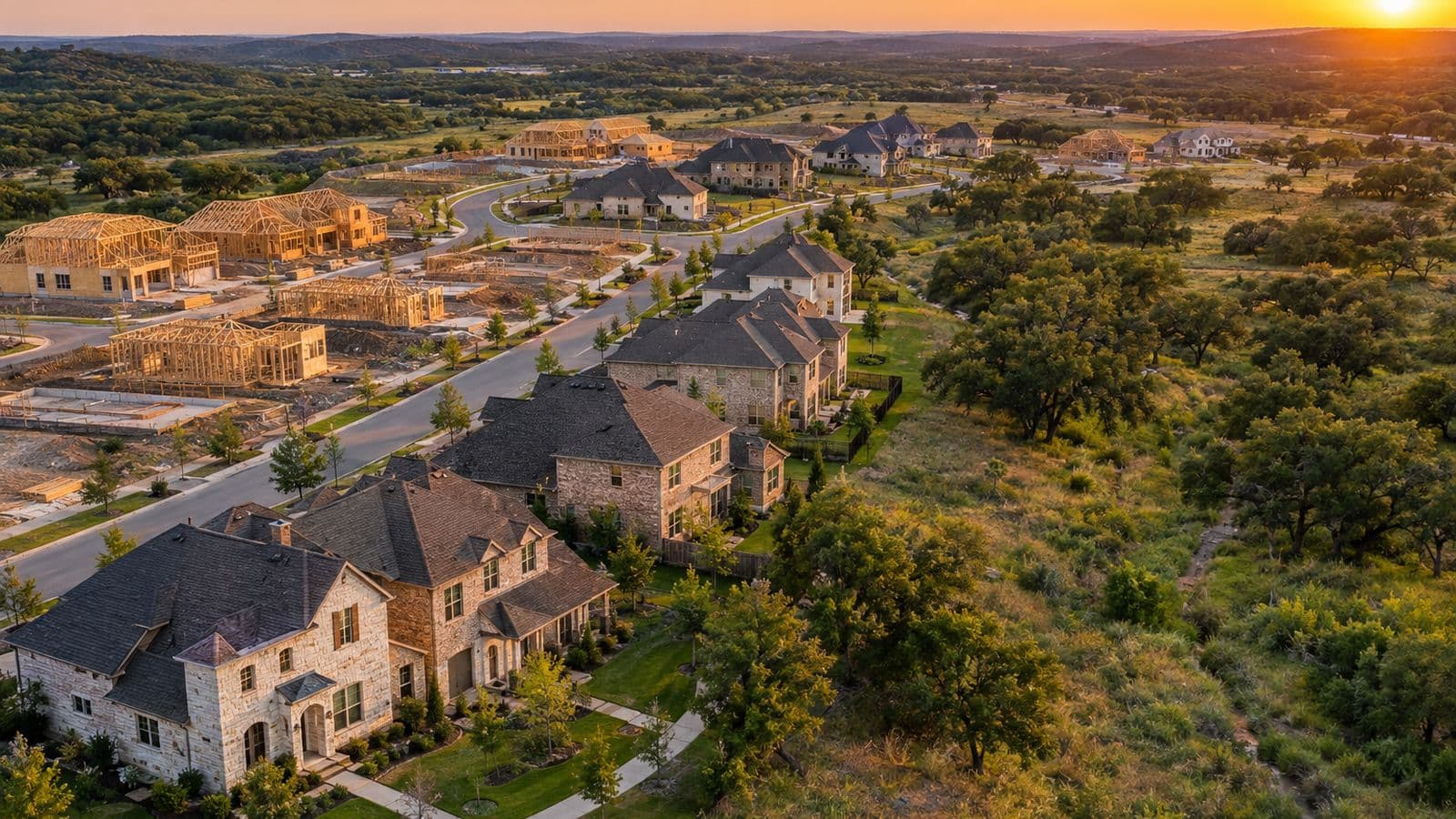
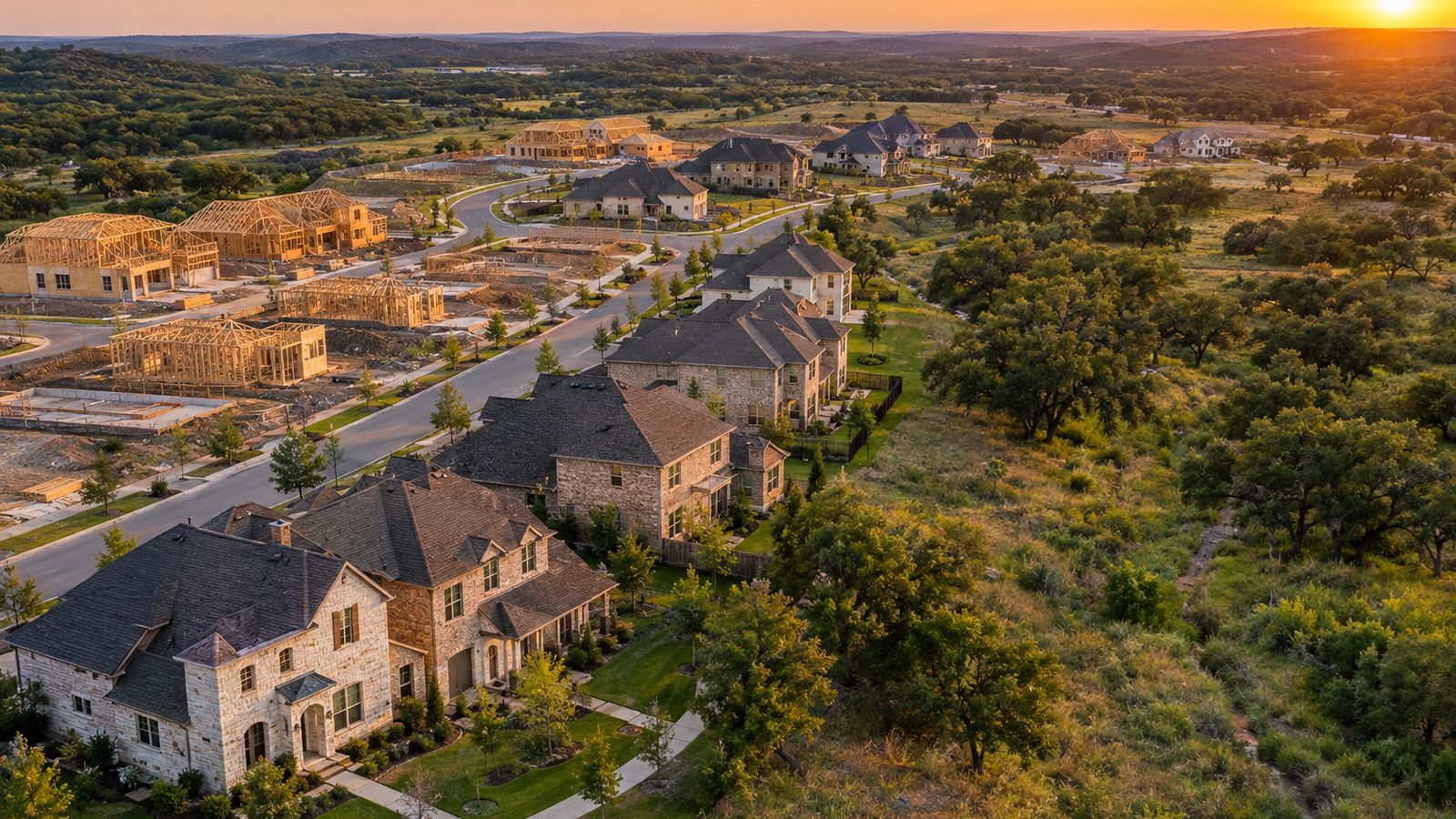
Not every new home carries the same pressure. A finished home that has not sold costs the builder taxes, insurance, utilities and interest every month it sits. A home that has not been started costs the builder almost nothing to wait on. That difference usually shapes where the larger offers appear, even inside one subdivision.
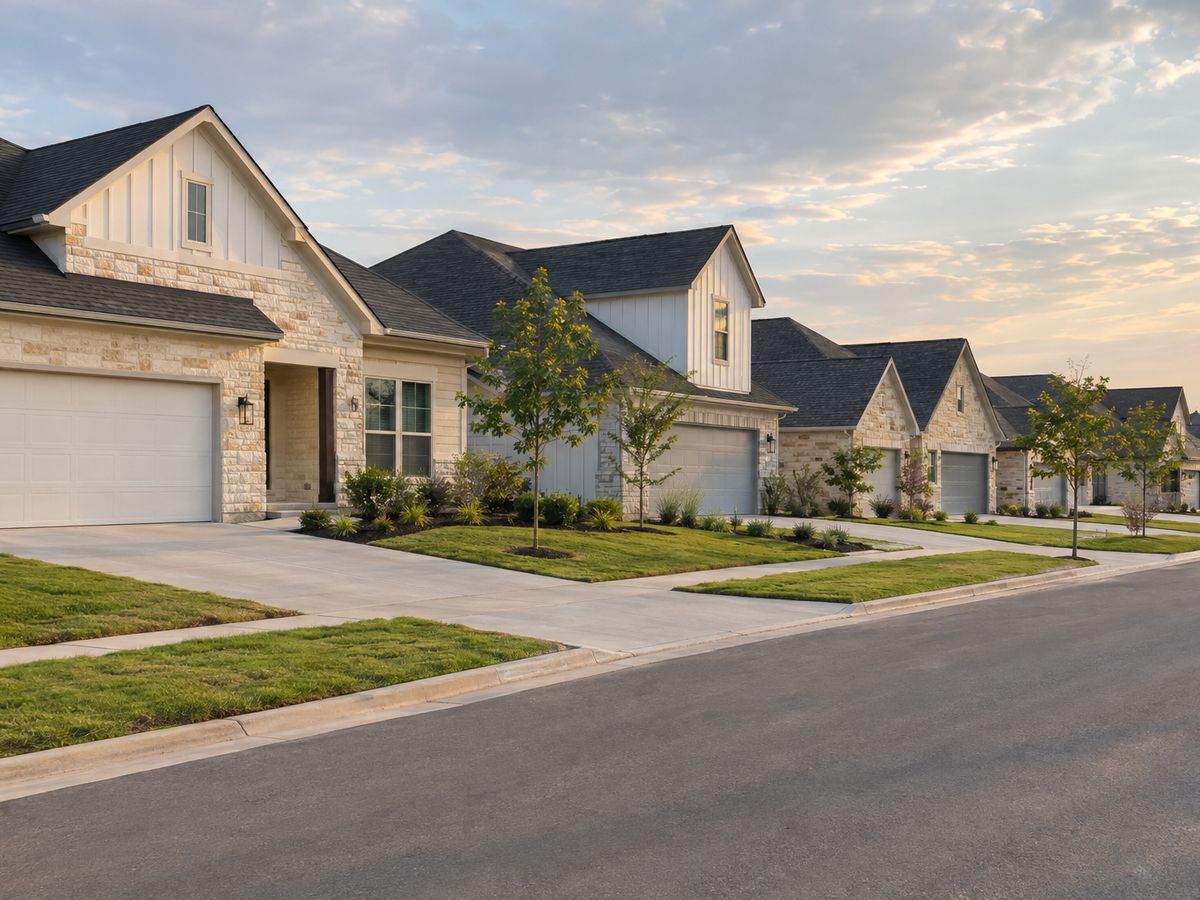
Three types of inventory show up on a typical Williamson County builder's price sheet:
- Finished, move-in-ready homes. Built on spec, often with design choices already made. These carry the carrying cost, so they tend to draw the largest closing-cost credits and rate buydowns, often tied to a near-term closing date.
- Homes under construction. Some selections may still be open. Offers are often smaller but come with more choice, and the closing date depends on the build schedule.
- To-be-built homes. Full choice of plan and finishes, a closing several months out and usually the smallest incentive. A rate buydown promised today may also need a long rate lock to survive until closing.
Supply differs by town. Georgetown, Leander, Hutto, Liberty Hill and Jarrell each have active master-planned communities at different stages. A community in its final phase may have a few spec homes left and a reason to clear them. One opening a new phase may be pricing to draw early contracts. Our area pages for Georgetown, Leander, Hutto, Liberty Hill and Round Rock describe the communities in each, and our Georgetown market report for October covers the resale side.
How an appraiser treats a builder's concession
An incentive that lowers the price and one that pays for closing costs or a buydown look alike on a flyer. Appraisers treat them differently. Fannie Mae requires appraisers to adjust comparable sales that included sales or financing concessions, such as buydowns, discount points and closing costs a buyer would normally pay, so the adjustment reflects what each home would have sold for without them (Fannie Mae Selling Guide B4-1.3-09). Those adjustments can only go down, never up. When a comparable is a builder sale from a competing project, the appraisal must discuss the concessions and upgrades on each one (Fannie Mae Selling Guide B4-1.3-08).
For a buyer, that has two effects. A large concession on your own contract may not raise the appraised value, so the contract price still has to stand on its own. And when you resell, nearby comparables with heavy concessions will be adjusted downward. For the limits on how much a seller can contribute toward your loan, and the math comparing a buydown with a price cut, see our 2-1 buydown guide.
The affiliated-lender condition and your right to shop
Most large builder incentives require using the builder's affiliated mortgage company, and often its title company. Federal rules allow this within limits. Under Regulation X, offering a discount for using a package of settlement services is not a prohibited "required use," but the package must be optional, and the discount must be a true discount that is "not made up by higher costs elsewhere in the settlement process" (12 CFR 1024.2, eCFR). A builder that refers you to a company it owns must also give you a written Affiliated Business Arrangement Disclosure Statement explaining the ownership and the estimated charges, no later than the referral (12 CFR 1024.15, eCFR).

The rule gives you a way to test an offer. Take the affiliated lender's Loan Estimate to at least one outside lender and compare total costs over the time you expect to keep the loan, not just the rate. The Consumer Financial Protection Bureau recommends collecting Loan Estimates from more than one lender for exactly this comparison (CFPB Loan Estimate explainer). If the outside loan is close, the incentive is real money. If the affiliated loan has a higher origination charge or a pricier title package, part of the incentive is coming back to the builder.
Timing: year-end deadlines versus the spring reset
Many incentives carry a "close by" date, and late-year deadlines are common. Builders' fiscal calendars differ, though, so a December deadline does not always mark a builder's year end. D.R. Horton's fiscal 2027 began on October 1, and its management said on the call that it hoped for a better spring selling season. Spring is when foot traffic usually returns, and builders can pull back offers if it does. That is not a reason to rush. It is a reason to compare what is on the table now with what you would accept if the same home were still available in April.
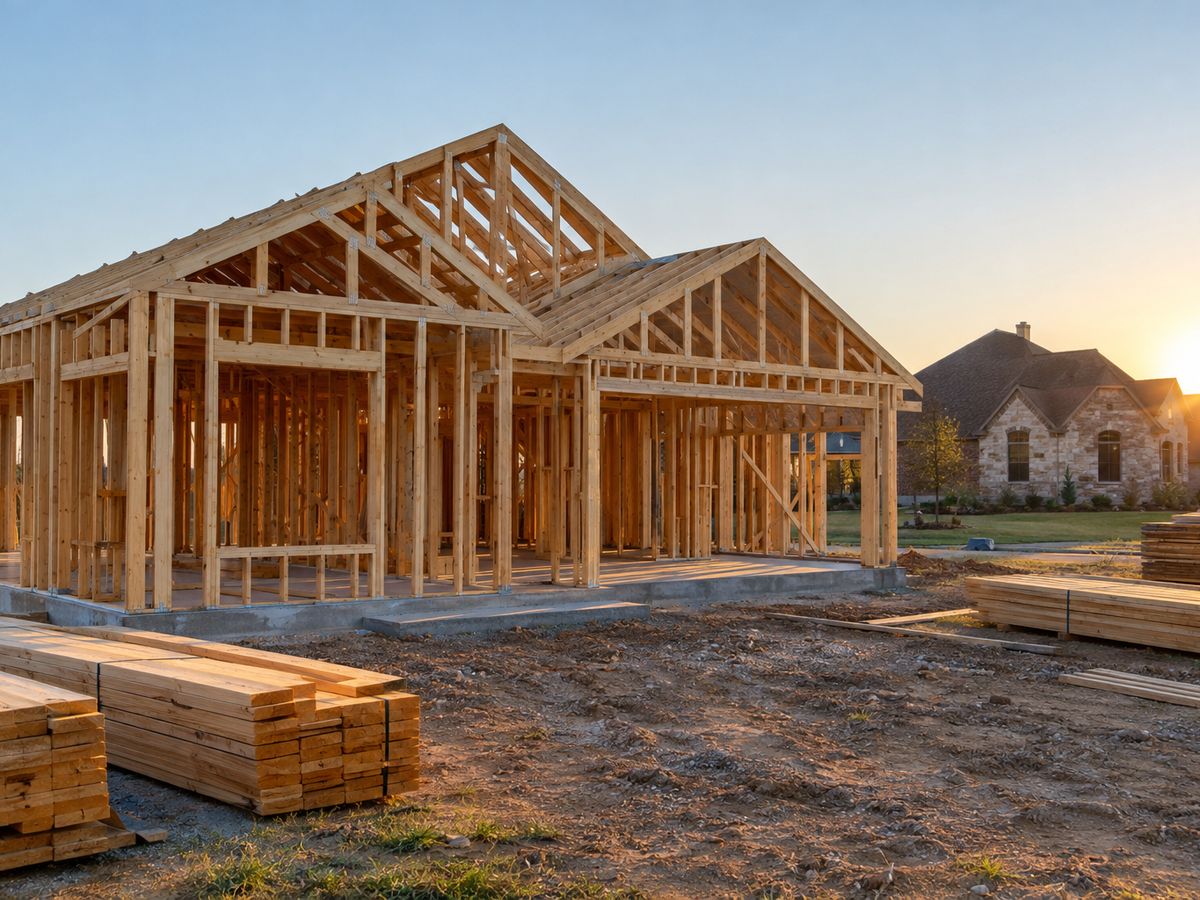
Property taxes also turn on the calendar. Texas appraises taxable property at its market value as of January 1 (Texas Tax Code §23.01). A home still being framed on that date is valued as it stood then, while a home finished in December is valued as complete for the coming tax year. That changes the first year's escrow estimate, so ask the lender how it set the tax figure. In master-planned communities, add the MUD or PID rate and HOA dues; our Wolf Ranch HOA, MUD and taxes page shows how those stack up. On rates, our rate lock guide covers how long a lock needs to last for a home that is not finished yet.
What to get in writing before signing
Many builders use their own sales agreement rather than a TREC form, so the incentive terms need to be in the contract or an addendum, not just a flyer. Before you sign, confirm:
- The dollar amount of each incentive and what it pays for: price, closing costs, rate buydown, upgrades or appliances.
- Every condition attached, including the required lender or title company and the deadline to close.
- What happens if the builder, not you, misses the completion date, and whether the incentive survives the delay.
- Whether a promised rate depends on a lock, how long that lock lasts and who pays to extend it.
- How the builder values included upgrades. A design-center price is not the same as appraised value.
- That you have the Affiliated Business Arrangement Disclosure Statement and a Loan Estimate you can compare.
- Your access for independent inspections at the pre-pour, pre-drywall and final stages. Our new construction inspection guide explains each one.
For how the broader 2027 outlook fits together, see our Austin housing market forecast for 2027. To compare a builder's offer with nearby resale homes, contact Paragon Realty Group.
Frequently asked questions
Are builders in Williamson County offering bigger incentives right now?
Most national builders say incentives remain elevated, and Texas new-home sales fell for five straight months through October 2026. NAHB's November survey found 68% of builders using incentives and 46% cutting prices. Offers differ by builder, community and home, and finished spec homes usually carry the largest ones. Check the current price sheet for each community you are considering, and ask whether an offer depends on a closing date or a particular lender before you compare it with another.
Is a price cut or a closing-cost credit worth more?
The answer turns on your holding period for the home and the loan. A price cut lowers the loan amount and the down payment for the life of the loan. A closing-cost credit or rate buydown lowers cash at closing or early payments, but appraisers adjust comparable sales for those concessions. Ask the builder to show both options in dollars, and have a lender run the payment and total cost of each over your expected holding period.
Must I use the builder's mortgage company to keep incentives?
Usually yes, if you want the incentives tied to financing, but federal rules require the arrangement to be optional and disclosed. A builder may offer a discount for using its affiliated lender and title company. It must give you a written affiliated business disclosure, and the discount cannot be made up through higher costs elsewhere. Getting a Loan Estimate from an outside lender is the clearest way to check whether the package is a real discount.
When do builders usually offer their largest year-end incentives?
Many builders set incentive deadlines late in the year, but fiscal years vary, so there is no single month. D.R. Horton's fiscal year ended September 30, for example. What matters more is inventory. A finished home that has sat for months usually draws a larger offer than one not yet started. Compare the offer against the home's days on market and the number of finished homes in that community.
Why did national new-home sales rise while Texas sales fell?
The two reports count different things. The Census Bureau's national figure counts signed contracts from a builder sample, and October's 14.2% gain had a margin of error of 22.6%. The Texas report counts MLS closings and pendings in four metros, smoothed over three months. Both show elevated supply. Census counted 8.0 months of new homes for sale nationally, with 112,000 already finished, which keeps pressure on builders to keep offering incentives.
Joseph Stancil, TX License #760204, Paragon Realty Group, brokered by eXp Realty, LLC, TX Broker License #603392. General information, not legal, tax or financial advice. Builder incentives change often and vary by community and home; confirm every offer and its conditions in the builder's written contract. Nothing here is an offer of credit or a rate quote. Sources: HomesUSA.com Texas New Home Sales Reports via GlobeNewswire (July 22, October 22 and November 24, 2026); U.S. Census Bureau and HUD New Residential Sales for October 2026 (November 25, 2026); NAHB press releases (November 17 and November 25, 2026); D.R. Horton fourth-quarter fiscal 2026 earnings release and call transcript (October 29, 2026); 12 CFR 1024.2 and 1024.15 (eCFR); Fannie Mae Selling Guide B4-1.3-08 and B4-1.3-09; Consumer Financial Protection Bureau Loan Estimate explainer; Texas Tax Code §23.01. All sources accessed November 28, 2026. Paragon Realty Group is not affiliated with HomesUSA.com, the U.S. Census Bureau, HUD, NAHB, D.R. Horton, Fannie Mae or the Consumer Financial Protection Bureau, or with any builder named or described. Illustrations are AI-generated and do not show an actual property or community.

Joseph Stancil
Founder & Supervising Agent | Paragon Realty Group
Joseph Stancil, first licensed in real estate in 2012 and in Texas since 2021, writes every article in The Paragon Chronicle. His market analysis draws on proprietary data, direct transaction experience, and deep relationships throughout Austin's luxury communities.