


Houston, Dallas–Fort Worth and San Antonio send the most movers to Austin in new IRS 2023–2024 data; Los Angeles leads out of state, and the metro gained 13,916 people net.
By Joseph Stancil, REALTOR® since 2012, Paragon Realty Group, brokered by eXp Realty, LLC (TREC broker license #603392). Texas Sales Agent License #760204.
What the new IRS file shows
The IRS Statistics of Income division posted its 2023–2024 migration data on November 19–20, 2026. It tracks tax returns whose address moved from one county to another between returns filed in 2023 and returns filed in 2024. We added up the five counties in the Austin–Round Rock–San Marcos metro (Bastrop, Caldwell, Hays, Travis and Williamson) and matched every other county to its metro area.
Here is the metro-level picture for moves within the United States, leaving out moves from one Austin-area county to another:
| Flow, 2023–2024 | People in | People out | Net |
|---|---|---|---|
| All U.S. moves from outside the metro | 105,910 | 91,994 | +13,916 |
| From or to other states | 58,066 | 47,638 | +10,428 |
| From or to the rest of Texas | 47,844 | 44,356 | +3,488 |
| Same flows, 2022–2023 (all U.S.) | 112,105 | 95,098 | +17,007 |
Three things stand out. Austin still gained people through migration. The gain was smaller than a year earlier. And the mix shifted toward Texas: the metro's net gain from other states fell from about 17,500 people to about 10,400, while the exchange with the rest of Texas went from a small loss (−454) to a gain of 3,488.
"People" in the IRS file means filers plus the dependents claimed on each return. Abroad, the file shows 1,272 people arriving from foreign addresses and 1,739 leaving, a much smaller flow than the domestic one.
The 12 largest metro flows in and out of Austin
Ranked by total people moving in both directions, these are the metro pairs with the most traffic:
| Metro area | Moved to Austin | Moved from Austin | Net for Austin | Avg. AGI per arriving return |
|---|---|---|---|---|
| Houston | 10,384 | 7,640 | +2,744 | $89K |
| Dallas–Fort Worth | 9,095 | 8,340 | +755 | $117K |
| San Antonio | 8,044 | 8,793 | −749 | $72K |
| Killeen–Temple | 4,493 | 4,549 | −56 | $54K |
| Los Angeles | 3,418 | 1,770 | +1,648 | $143K |
| New York | 2,668 | 1,941 | +727 | $129K |
| Seattle | 1,940 | 1,644 | +296 | $183K |
| San Francisco–Oakland | 1,986 | 1,115 | +871 | $212K |
| Chicago | 1,690 | 1,313 | +377 | $128K |
| Denver | 1,169 | 1,606 | −437 | $128K |
| San Jose | 1,628 | 895 | +733 | $233K |
| Miami | 1,735 | 788 | +947 | $84K |
The big Texas metros dominate by volume. Houston alone accounts for more than 18,000 people moving one way or the other, and it is the single largest net source for Austin. Dallas–Fort Worth is nearly as busy but much closer to even. San Antonio is the clearest case of traffic running the other way: more people moved from the Austin metro to the San Antonio–New Braunfels metro than came north.
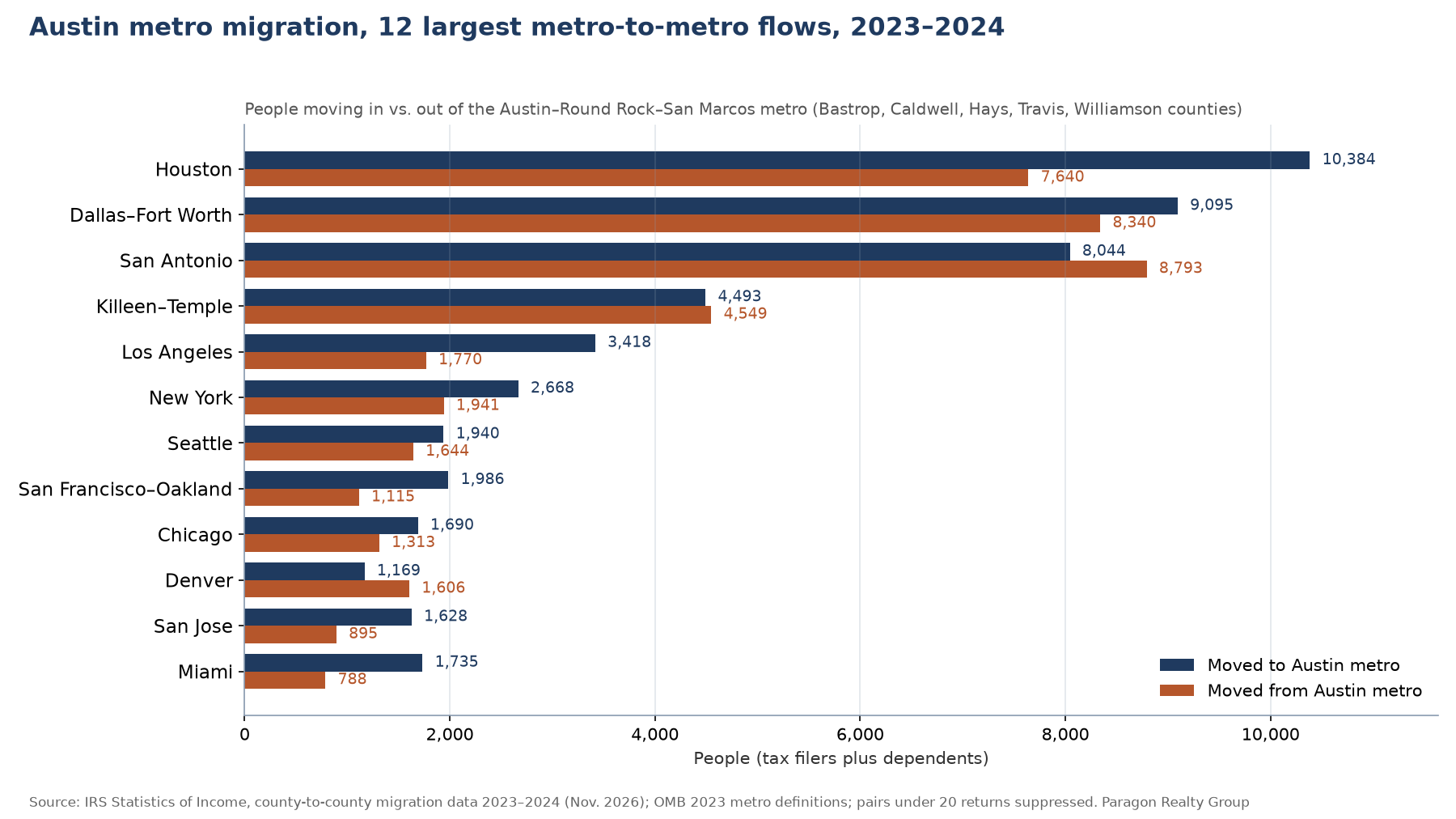
The Killeen–Temple metro trades almost exactly as many people with Austin as it receives. Much of that is the normal back-and-forth of a large neighboring job center an hour up the highway.
Moving to Austin from California: what the numbers show
California remains the largest out-of-state source. Adding up every California county pair large enough to be published, 10,507 people moved from California to the Austin metro and 5,420 moved from Austin to California, a net gain of about 5,090. A year earlier the same count was 11,932 in and 5,252 out, so the California flow is still strongly one-directional but somewhat smaller.
By metro, Los Angeles (Los Angeles and Orange counties) is the largest, followed by San Francisco–Oakland, San Jose and San Diego (1,300 in, 808 out). Every one of those four ran a net gain for Austin.

If you are moving to Austin from California, the practical questions tend to be the same ones: how property taxes compare with your current bill, what a commute from Georgetown, Leander or Kyle looks like, and how far a budget goes in each part of the metro. Our Austin cost of living breakdown walks through housing payments, rent, utilities and everyday prices, and the Austin neighborhood guide compares areas by commute, school district, lot size and value.
Where Austin loses people
Not every flow runs toward Austin. Among the 12 largest pairs, three moved people away from the metro on net:
- San Antonio–New Braunfels: 749 more people left Austin for this metro than arrived from it.
- Denver–Aurora–Centennial: 1,606 people moved from Austin to the Denver area, against 1,169 coming the other way, a net loss of 437.
- Killeen–Temple: essentially even, with a net loss of 56.
Outflows are a normal part of a large metro. People take jobs elsewhere, move closer to family or head to a smaller town for more land. The IRS file shows that about 92,000 people left the Austin metro for other U.S. counties in one year, even as more arrived.
Income on arriving returns: read the averages carefully
The IRS file includes total adjusted gross income (AGI) for each flow, which lets you compute an average per return. Arriving returns from the Bay Area reported the highest averages: about $233,000 per return from San Jose, $212,000 from San Francisco–Oakland and $183,000 from Seattle. Returns arriving from Houston averaged about $89,000, and from San Antonio about $72,000.
A few cautions keep these figures in proportion:
- Per return, not per person or household. A married couple filing jointly is one return.
- Income from the year before the move. The AGI comes from the second-year return, which reports income earned in 2023. Someone who changed jobs when they moved may earn something quite different now.
- Averages are pulled by a small number of large incomes. A median would likely be lower, but the IRS does not publish one for these flows.
- Metro-wide, arrivals and departures look alike. Across all U.S. moves into the Austin metro, the average was about $96,800 per return, compared with about $98,700 for returns leaving.
These numbers describe flows of tax returns between places. They do not describe any individual or group of movers, and they are not a guide to who belongs in any neighborhood.
Moves within the metro, and what it means for Georgetown
The five-county totals above leave out moves between Austin-area counties, which are large on their own: 61,405 people changed counties inside the metro. The biggest single flow is Travis to Williamson, with 20,410 people moving from Travis County into Williamson County and 13,881 going the other way, a net gain of 6,529 for Williamson.

That pattern shows up on the ground in places like Georgetown, Leander and Hutto, where new subdivisions and older town centers both draw buyers moving out from the core of the metro. For current listing prices and inventory across the metro, see our Austin housing market update for October 2026.
How the IRS counts a move
The method is simple to describe and worth knowing before you quote the numbers. According to the IRS migration data users guide:
- Source: individual income tax returns filed and processed in calendar years 2023 and 2024, matched across years. Prior-year returns filed late are not used.
- A move: a return whose county changed from the first year's filing to the second year's. Returns with the same county both years are counted as non-migrants.
- Address: the mailing address on the return, which may not be the taxpayer's home. A taxpayer who moved after the tax year ended may already file from the new address.
- Who is missing: people not required to file a return, and filers claimed as dependents in the second year.
- Privacy rules: county-to-county pairs with fewer than 20 returns are not shown. That means small flows from distant counties drop out, so sums of published pairs (like the California total above) run slightly low.
- Units: n1 is returns, n2 is individuals, and AGI is in thousands of dollars.
To build the metro totals, we grouped counties using the Office of Management and Budget's 2023 metro definitions, published as Census Bureau delineation files. For metro totals we used each county's published U.S. migration total and subtracted moves between the five Austin-area counties, so these figures include the suppressed small flows that the pair-by-pair table cannot.
IRS data complements, rather than replaces, the Census Bureau's population estimates program and the projections from the Texas Demographic Center. Census estimates include births, deaths and international migration, so their totals will not match the IRS counts.

Relocating to Austin or Georgetown? Talk with Joseph
Migration data shows the overall flows. Your move comes down to a specific commute, budget and timeline. If you are relocating from Houston, Dallas, California or anywhere else, start with our relocation guide, or contact Joseph to talk through areas, new construction versus resale, and how to tour efficiently from out of town.
Frequently asked questions
Where are most people moving to Austin from?
Houston sends the most people to the Austin metro, followed by Dallas–Fort Worth and San Antonio. In the IRS 2023–2024 data, 10,384 people moved from the Houston metro to the Austin metro, 9,095 from Dallas–Fort Worth and 8,044 from San Antonio. Outside Texas, the largest source was the Los Angeles metro with 3,418 people, followed by New York, San Francisco–Oakland and Seattle. These counts come from address changes on tax returns filed in 2023 and 2024.
Are people still moving to Austin from California?
Yes, California remained the largest out-of-state source in 2023–2024. Published IRS county pairs show 10,507 people moving from California to the Austin metro and 5,420 moving the other way, a net gain of about 5,090. That is a bit lower than the year before, when 11,932 came and 5,252 left. Los Angeles, San Francisco–Oakland, San Jose and San Diego each sent more people to Austin than they received.
Is Austin losing more people than it gains?
No, the Austin metro still gained people through domestic migration in 2023–2024. About 105,910 people moved in from other U.S. counties and about 91,994 moved out, a net gain of 13,916. That gain was smaller than the 17,007 recorded in the 2022–2023 data. San Antonio and Denver were two of the larger metros where more people left Austin than arrived, a normal pattern for any large, fast-growing metro.
How does the IRS track where people move?
The IRS compares the address on each person's tax return from one year to the next. If the county changed between returns filed in 2023 and 2024, the return counts as a move. The data counts both returns and the people listed on them. Pairs of counties with fewer than 20 returns are suppressed for privacy, and people who are not required to file are not included.
What income do people moving to Austin report?
Arriving returns averaged about $96,800 in adjusted gross income across all U.S. moves. Averages varied widely by origin: about $233,000 per return from San Jose and $212,000 from San Francisco–Oakland, versus about $89,000 from Houston. These are per-return averages based on income earned in 2023, so they describe flows between places and can be pulled upward by a small number of large incomes.
Joseph Stancil, TX License #760204, Paragon Realty Group, brokered by eXp Realty, LLC, TX Broker License #603392. General information, not legal, tax or financial advice. Sources: IRS Statistics of Income, "SOI Tax Stats – Migration data 2023–2024" and county inflow and outflow files (page updated November 20, 2026); IRS, Migration Data Users Guide and Record Layouts, 2023–2024; IRS 2022–2023 county migration files for the prior-year comparison; Office of Management and Budget metro definitions (July 2023), via U.S. Census Bureau delineation files. Metro totals, averages and rankings are Paragon Realty Group calculations from the IRS files. All sources accessed November 22, 2026. Paragon Realty Group is not affiliated with the IRS, the Census Bureau, the Texas Demographic Center or any organization named. If you are already in a written agreement with another broker, this is not a solicitation of your business. Illustrations are AI-generated and do not show an actual home, street or place.

Joseph Stancil
Founder & Supervising Agent | Paragon Realty Group
Joseph Stancil, first licensed in real estate in 2012 and in Texas since 2021, writes every article in The Paragon Chronicle. His market analysis draws on proprietary data, direct transaction experience, and deep relationships throughout Austin's luxury communities.