


Austin's cost of living sits about 2% below the U.S. average on C2ER's index, but housing runs higher: about $4,290 a month to own a median-priced home versus $1,740 median rent.
By Joseph Stancil, REALTOR® since 2012, Paragon Realty Group, brokered by eXp Realty, LLC (TREC broker license #603392). Texas Sales Agent License #760204.
Austin's cost of living at a glance
| Measure | Austin | Comparison | Source and period |
|---|---|---|---|
| C2ER composite Cost of Living Index | 98.0 | U.S. average = 100 | C2ER, Q2 2026 |
| Median household income | $93,706 | U.S. $84,780 | Census ACS 1-year, 2025 |
| Median gross rent | $1,740 a month | U.S. $1,557 | Census ACS 1-year, 2025 |
| Median owner cost, homes with a mortgage | $2,881 a month | U.S. $2,163 | Census ACS 1-year, 2025 |
| Median sale price, City of Austin | $550,000 | Metro $404,802 | Unlock MLS, October 2026 |
| 30-year fixed mortgage, national average | 7.28% | 6.26% a year earlier | Freddie Mac PMMS, Nov. 19, 2026 |
| Living wage, one adult, Travis County | $23.69 an hour | $49,279 a year before taxes | MIT Living Wage Calculator, 2026 data |
The picture that comes out of these numbers: everyday prices in Austin land close to the national norm, Texas collects no state income tax, and housing is where the budget gets decided. The rest of this guide takes each line item in turn, with the source and date for every figure.
How Austin compares with other cities
The Council for Community and Economic Research (C2ER) prices a standard basket of goods and services in roughly 250 participating urban areas each quarter. In the second quarter of 2026, Austin's composite index was 98.0, Dallas was 99.3, Houston 93.7, Fort Worth 93.0 and Plano 103.5, according to a September 1, 2026 release from the Greater Brazos Partnership that reported the C2ER results. Nationally, the quarter ranged from 228.8 in Manhattan to 79.0 in Ponca City, Oklahoma.
Two cautions apply when comparing the cost of living in Austin with other cities. First, C2ER's basket reflects a professional and managerial household's spending, and its housing component prices a defined standard home rather than the typical home sold, so it can sit well below what Austin's MLS medians suggest. Second, the index leaves out income taxes. Texas has no personal state income tax, which matters most when comparing Austin with places like California, New York or Colorado.
A cleaner comparison for a move is to price your own budget on both ends: the rent or payment you would carry, plus utilities, taxes and insurance.
The monthly cost of owning a median-priced home
Unlock MLS reported a $550,000 median sale price for the City of Austin in October 2026, flat from a year earlier (Unlock MLS October 2026 Central Texas Housing Report). Here is what that home costs per month with 20% down, the down payment Freddie Mac's survey assumes:
| Line item | Monthly | Basis |
|---|---|---|
| Principal and interest | $3,011 | $440,000 loan, 30-year fixed at 7.28% |
| Property taxes | $764 | 2026 rates for AISD, the city, the county, Central Health and ACC, homestead applied |
| Homeowners insurance | $291 | Texas statewide average premium of $3,489 a year |
| Electricity | $122 | Austin Energy typical bill, 860 kWh |
| Water and wastewater | $108 | Austin Water typical bill |
| Total | $4,295 |
The rate is Freddie Mac's Primary Mortgage Market Survey average for the week of November 19, 2026. It describes conventional purchase loans with 20% down and excellent credit, so it is a benchmark, not a quote. Your rate depends on credit, loan type, points and timing, and the Loan Estimate a lender issues within three business days of your application is the document that shows your actual figures. Every 0.25-point change in the rate moves this payment by roughly $75 a month.
The tax line uses the rates and homestead exemptions explained in our homestead exemption guide. In your first year, before the exemption applies, the same home would carry about $972 a month in property taxes. The insurance line is the statewide average from the Texas Department of Insurance market overview (2025 preliminary data), so a quote for a specific roof, age and coverage level may differ in either direction.
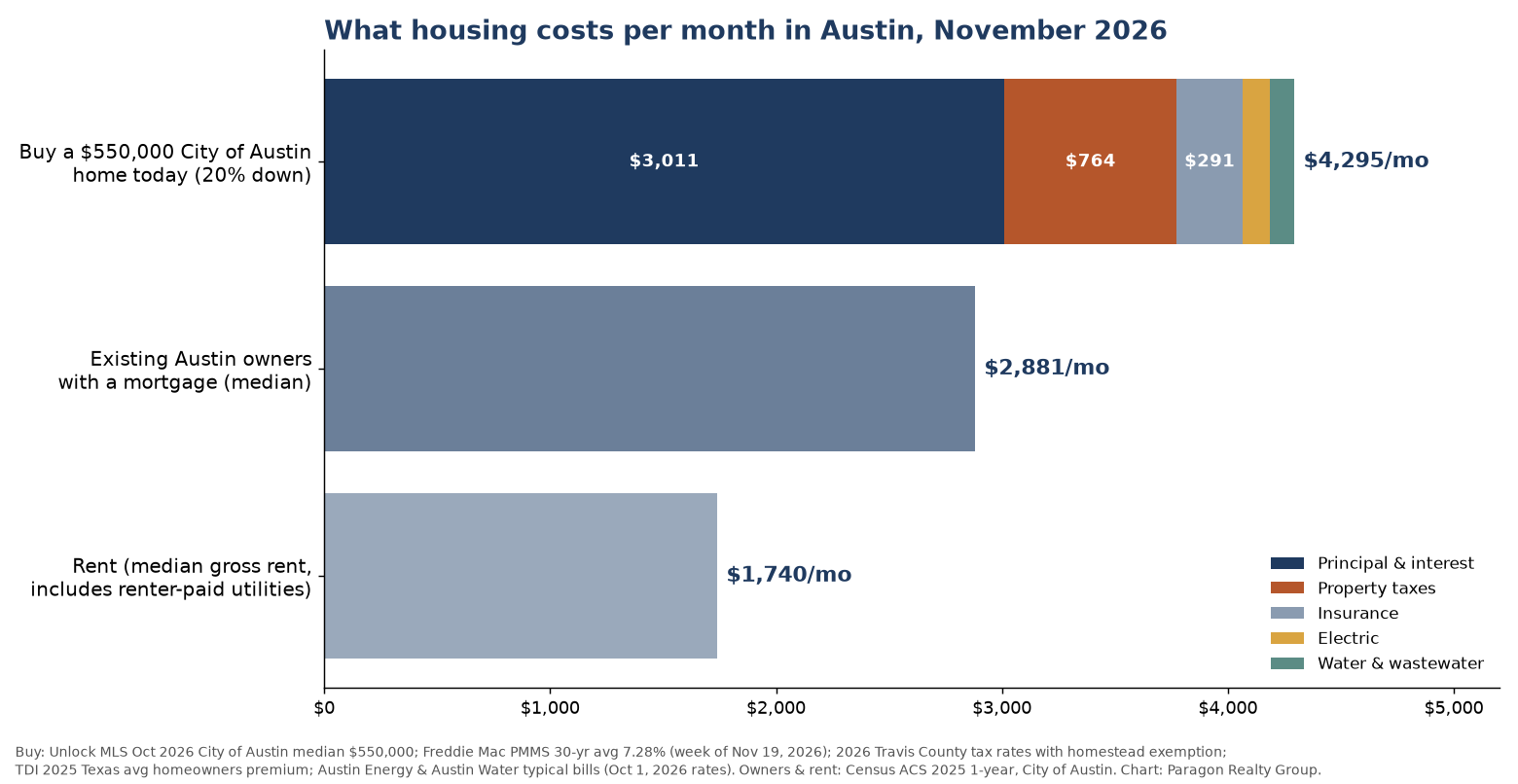
The middle bar matters. Austin owners who already have a mortgage pay a median $2,881 a month in selected owner costs, according to the Census Bureau's 2025 American Community Survey. Many of them bought earlier or locked lower rates, which is why a buyer today faces a larger number than the neighborhood average suggests.
Renting in Austin
Median gross rent in the City of Austin was $1,740 a month in 2025, down from $1,770 in 2024, per the same Census survey. Gross rent includes utilities when the renter pays them, so it is closer to an all-in housing figure than an advertised asking rent. About 60% of occupied homes in the city are rented.
Two things make Austin rent comparisons tricky. Newer apartment buildings often add parking, trash, pest control and amenity fees to the base rent, so ask for the full monthly total before comparing listings. And concessions such as a free month spread across a lease lower the effective rent but not the renewal rent.
Electric and water bills inside the city
The City of Austin owns both utilities, so rates are set in the city budget each fall. New rates took effect October 1, 2026:
- Electricity: Austin Energy's own example bill for a household using 860 kWh a month comes to $121.94 under the current four-tier residential rate, including the 1% city sales tax (Austin Energy residential rates). Base rates rose 5% this year while the fuel charge fell 5%, for a net increase of about $3.66 a month on the average bill. Summer air conditioning pushes many homes into the 901 to 2,000 kWh tier, where the energy charge rises to 7.901 cents per kWh.
- Water and wastewater: Austin Water's typical residential bill, based on 5,800 gallons of water and 4,000 gallons of wastewater, rose $7.76 to $107.67 a month (Austin Water rates and fees). Lawn irrigation in summer moves usage into the higher tiers fast.
Trash, drainage and other city fees appear on the same combined bill. Homes outside city limits are often served by an electric cooperative and a separate water utility or municipal utility district, so ask the seller or landlord for 12 months of bills.
Groceries, gas and everyday prices
Austin doesn't have its own Consumer Price Index; the Bureau of Labor Statistics folds it into the South region. That index was unchanged from September to October 2026, with energy prices down 1.4% for the month and food up 0.3% (BLS, Consumer Price Index, South Region, October 2026). The latest published 12-month change for the South was 3.4%, through September 2026.

Transportation is the other large line for most Austin households. The MIT Living Wage Calculator budgets $8,465 a year for transportation for one adult in Travis County, close to half of its $18,213 housing figure. Commute distance and the number of cars in the household move that number more than gas prices do.
How much income it takes to live in Austin
The MIT Living Wage Calculator for Travis County (2026 data, updated February 15, 2026) estimates the pre-tax income needed to cover basic expenses:
- One adult, no children: $23.69 an hour, or $49,279 a year.
- Two adults, one working, no children: $31.49 an hour.
- Two working adults with two children: $27.53 an hour each, or $114,530 a year combined, with child care alone at $25,274.
Those are minimum-needs budgets that assume renting. Buying is a different test. The $4,295 monthly cost above adds up to about $51,500 a year. Lenders look at total monthly debt against gross income, and a common guideline keeps housing near 28% to 30% of gross income. Under that guideline, a median-priced City of Austin home calls for roughly $172,000 a year in household income with 20% down, compared with a $93,706 median household income in the city.
Where the monthly number moves most
Price is the biggest lever. Every $50,000 change in purchase price moves principal and interest by about $274 a month at 7.28% with 20% down. Unlock MLS put the October 2026 median at $480,000 for Travis County as a whole and $375,250 for Williamson County, and our Austin neighborhoods guide compares home values ZIP by ZIP. Areas such as Pflugerville, Hutto and Kyle carry lower typical values, though a longer commute and municipal utility district taxes can offset part of the difference.
A few other levers:
- File the homestead exemption. It lowers the yearly tax bill once you own and occupy the home.
- Compare the tax rate, not just the price. Two homes at the same price can carry different bills depending on the city, school district and any utility district.
- Ask for insurance quotes before your option period ends. Roof age, construction and claims history all change the premium.
- Check the summer bills. July and August electric and water bills tell you more than an annual average.
For timing a mortgage rate, see when Austin buyers should lock. If you're moving from another state, our relocation page explains how we help buyers settle in remotely.
Frequently asked questions
Is Austin, Texas expensive to live in compared with other cities?
Austin's overall prices are close to the U.S. average, but housing costs run higher than in most Texas metros. C2ER's composite index put Austin at 98.0 in the second quarter of 2026, against 99.3 for Dallas and 93.7 for Houston. Texas has no state income tax, which the index leaves out. The Census Bureau's 2025 survey shows Austin's median rent and owner costs above the national medians, so housing decides most budgets.
How much income do you need to live in Austin?
MIT's 2026 estimate for one adult in Travis County is $49,279 a year before taxes, enough for a basic renter's budget. Two working adults with two children need about $114,530 combined. Buying raises the bar: the roughly $4,295 monthly cost of a $550,000 City of Austin home works out to about $172,000 of household income under a 30% housing guideline. Your lender's debt-to-income review will set the actual limit.
What is the average rent in Austin right now?
The Census Bureau put median gross rent in the City of Austin at $1,740 a month in 2025, down from $1,770 a year earlier. Gross rent includes utilities the renter pays, so it runs higher than many advertised rents. Newer buildings often add parking, trash and amenity fees. Ask each landlord for the full monthly total, and compare effective rent after concessions with the rent you would pay at renewal.
How much are utilities per month in Austin?
A typical Austin household pays about $230 a month for electricity, water and wastewater at rates effective October 1, 2026. Austin Energy's example bill at 860 kWh is $121.94, and Austin Water's typical bill is $107.67. Summer air conditioning and lawn watering push many homes into higher-priced tiers. Trash and drainage fees appear on the same city bill, so request a year of statements before you sign or close.
How much are property taxes on an Austin home?
Inside both the city limits and AISD, 2026 taxes on a $550,000 home come to about $9,165 a year with a homestead exemption. That is roughly $764 a month across the school district, city, Travis County, Central Health and Austin Community College. Without the exemption, the bill would be about $11,666. Homes in municipal utility districts or other special districts pay more, so check the appraisal district record for each parcel.
Joseph Stancil, TX License #760204, Paragon Realty Group, brokered by eXp Realty, LLC, TX Broker License #603392. General information, not legal, tax or financial advice. Sources: C2ER Cost of Living Index, Q2 2026, as reported by the Greater Brazos Partnership on September 1, 2026; U.S. Census Bureau American Community Survey 2025 1-year estimates (tables DP03 and DP04, released September 2026); Unlock MLS October 2026 Central Texas Housing Report (published November 11, 2026); Freddie Mac Primary Mortgage Market Survey for the week of November 19, 2026; Travis County Tax Office 2026 rates; Texas Department of Insurance homeowners market overview (2025 preliminary average premium); Austin Energy and Austin Water rates effective October 1, 2026; BLS Consumer Price Index, South Region, October 2026 (released November 10, 2026); MIT Living Wage Calculator, 2026 data. Payment estimates are Paragon Realty Group calculations and are not a loan offer; request a Loan Estimate from a lender for your figures. Data checked November 19, 2026, and subject to revision. Paragon Realty Group is not affiliated with any of these organizations. Illustrations are AI-generated, not photos of actual homes or properties.

Joseph Stancil
Founder & Supervising Agent | Paragon Realty Group
Joseph Stancil, first licensed in real estate in 2012 and in Texas since 2021, writes every article in The Paragon Chronicle. His market analysis draws on proprietary data, direct transaction experience, and deep relationships throughout Austin's luxury communities.