
A 2-1 buydown cuts your mortgage rate 2 points in year one and 1 point in year two, then the full note rate applies. A builder or seller usually prepays the gap at closing.
By Joseph Stancil, REALTOR® since 2012, Paragon Realty Group, brokered by eXp Realty, LLC (TREC broker license #603392). Texas Sales Agent License #760204.
How a 2-1 buydown works, year by year
The "2-1" names the two discounts. Your loan has one permanent interest rate, called the note rate. For the first 12 payments, you pay as if the rate were 2 percentage points below it. For the next 12, you pay as if it were 1 point below. From payment 25 on, you pay the note rate for the rest of the loan.
The lender still collects the full note-rate payment every month. The difference comes from a buydown account funded at closing. Fannie Mae's Selling Guide requires those accounts to be fully funded and held in custodial bank accounts, separate from the lender's own money. Your only interest in the funds is having them applied to your payments as they come due.
The Consumer Financial Protection Bureau puts the trade plainly: with a temporary buydown, a borrower gets a lower payment for a limited time in exchange for an up-front fee or a higher rate later, and payments usually rise each year until the buydown ends. Variations exist. A 1-0 buydown discounts only year one, and a 3-2-1 spreads three steps over three years.
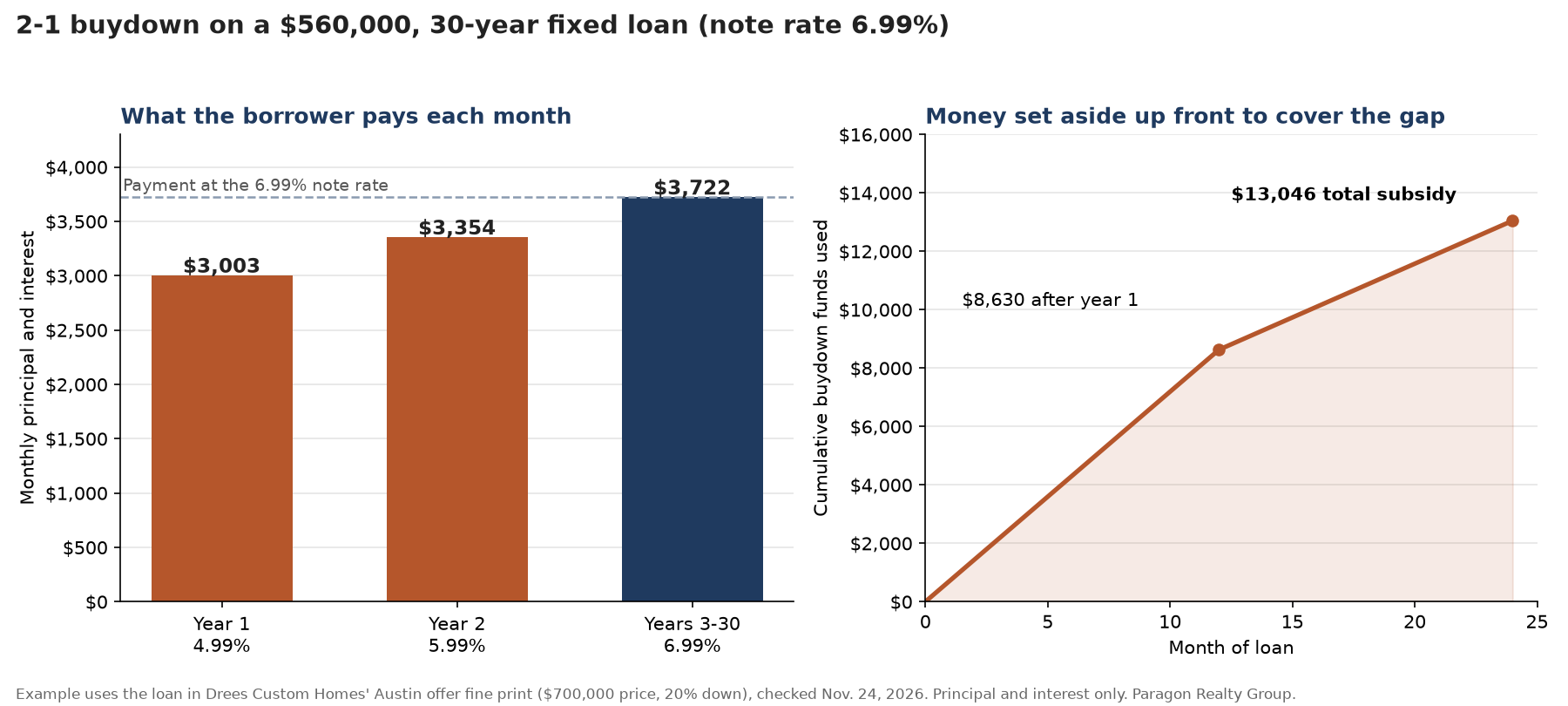
Here is what that looks like on the loan from Drees Custom Homes' current Austin offer: a $700,000 home, 20% down, a $560,000 30-year fixed loan and a 6.99% note rate. Figures are principal and interest only, before taxes, insurance, HOA dues and any mortgage insurance.
| Period | Rate used for the payment | Monthly principal and interest | Covered by buydown funds each month |
|---|---|---|---|
| Months 1-12 | 4.99% | $3,003 | $719 |
| Months 13-24 | 5.99% | $3,354 | $368 |
| Months 25-360 | 6.99% (note rate) | $3,722 | $0 |
Add those monthly gaps up and the buydown account needs about $13,046 at closing: roughly $8,630 for year one and $4,416 for year two.
Two Wolf Ranch offers, read line by line
Builder rate offers in Georgetown's Wolf Ranch are live this week, and two of them show how much the fine print matters. We track every builder's current offer, with links to the builders' own pages, on our Wolf Ranch builder incentives page.
Drees Custom Homes, Holiday Home Sale. Drees' Austin promotion page describes a true 2-1 buydown: payments figured at 4.99% for the first 12 months, 5.99% for the next 12 and the 6.99% note rate after that, with a 7.087% APR shown for all three periods. The fine print, checked November 24, 2026, says it applies to firm purchase agreements accepted from November 23 to December 31, 2026, closing by January 31, 2027, and financed with First Equity Mortgage, a Drees subsidiary. Government loans and adjustable-rate loans are excluded, and jumbo loans carry a different rate. Drees states you are not required to use its lender to buy the home, only to receive the advertised incentives.
Highland Homes, $0 Closing Costs offer. Highland's flyer pairs a builder closing-cost credit with a 4.99% first-year rate that becomes 5.99% from the second year through the end of the loan, shown at a 6.032% APR, on select inventory homes, with the purchase window ending November 29. That structure is different. The long-term rate is already 5.99%, and only year one is discounted, so it works like a 1-0 buydown layered over a reduced fixed rate. Our Highland Homes at Wolf Ranch page keeps the current terms and sources.
Notice the APRs. Drees' 7.087% APR is the same in every period because APR reflects the full-term cost of the note rate, not the teaser payment. The CFPB recommends comparing the costs of loans with and without the temporary rate, using APR to see which is cheaper over time.
What the market rate means for these offers
For context, the weekly Freddie Mac survey of lenders showed a 30-year fixed average of 7.28% for the week of November 19, 2026, up from 7.11% the week before and 6.26% a year earlier. Fortune's daily report, using Mortgage Research Center data, showed a 30-year conventional average of 7.145% on November 24, 2026, down from 7.339% a week earlier.
Against that backdrop, a 6.99% note rate is already a little under the national averages, and the first two years are well under them. That gap is the point of the marketing. It is also why the year-three payment deserves as much attention as the year-one payment. Averages are national snapshots for typical borrowers; your own rate depends on credit, down payment, loan type and the day you lock. Our guide to when Austin buyers should lock a rate covers how lock periods interact with build timelines.
The lending rules behind a temporary buydown
Most builder buydowns are on conventional loans sold to Fannie Mae or Freddie Mac, so Fannie Mae's guide sets the guardrails. Three rules matter most for a buyer.
You qualify at the full rate. Fannie Mae requires the lender to qualify the borrower based on the note rate without consideration of the bought-down rate. A buydown makes the first two years easier to live with. It does not raise the loan amount you are approved for.
The steps are capped. Under the same section, the rate reduction may not exceed 3 percentage points, the borrower's share may rise no more than 1 point per year, and the buydown period may not exceed 3 years. Temporary buydowns are allowed on primary residences and second homes but not investment properties or cash-out refinances.
Builder money counts toward a limit. When a builder, seller or an affiliated lender pays for the buydown, Fannie Mae counts the cost of that subsidy as an interested party contribution. For a primary residence or second home, the cap is 3% of value above 90% loan-to-value, 6% from 75.01% to 90% and 9% at 75% or less; investment properties are capped at 2%. On the $700,000 example with 20% down, the cap is $42,000, and the buydown, closing-cost credits and other financing concessions all draw from it.
FHA, VA and jumbo loans follow their own rules, which is one reason builders often limit buydown offers to conventional loans. Ask the lender which rule set applies to your file.
Buydown, price cut or rate reduction: run the same dollars three ways
A builder's incentive budget can usually be spent more than one way, and the dollars behave differently. Using the same $13,046 from the example:
- As a 2-1 buydown: about $719 a month off in year one and $368 in year two, then nothing.
- As a price reduction: the loan falls to about $549,563 and the payment to about $3,653, roughly $69 a month lower for all 30 years, plus about $2,609 less down payment at 20% down. A lower price can also mean a lower appraised basis and, over time, lower property taxes, since Texas taxes on appraised value.
- As a permanent rate reduction: the same dollars paid as discount points lower the note rate for the life of the loan. How far depends on the lender's pricing that day, so ask for a written quote.
None of these is automatically right. A buydown front-loads the help, which suits buyers who expect higher income soon or who plan to refinance if rates fall. A price cut or permanent rate change favors buyers who plan to keep the loan for years. Our mortgage calculator lets you test each version with your own numbers.
If you refinance or sell before the buydown ends, Fannie Mae says buydown funds are not refundable unless the mortgage is paid off before all the funds have been applied. Ask the lender what the buydown agreement says happens to any balance at payoff.
Get a Loan Estimate before you compare anything
A builder flyer is an advertisement. A Loan Estimate is the standardized three-page disclosure a lender must give you, and the CFPB says the lender must provide it within three business days of receiving your application. The CFPB's Loan Estimate explainer suggests comparing origination charges, services you cannot shop for, and the Comparisons section, including APR and Total Interest Percentage.
Request one Loan Estimate that includes the buydown from the lender tied to the builder and, for the same loan type, a Loan Estimate from at least one outside lender without it. The CFPB's mortgage shopping guide recommends comparing at least three offers. Then line up the note rate, APR, cash to close and the year-three payment side by side. Sometimes the builder's package wins; sometimes an outside loan plus a price or closing-cost concession does. You will only know from the documents.

Questions to ask a builder before you sign
- What is the note rate, and what payment will I owe in year three?
- Is this a 2-1, a 1-0 or a 3-2-1, and is the long-term rate itself reduced?
- Which lender is required for the incentive, and is there a non-lender incentive if I bring my own financing?
- What is the closing deadline, and what happens to the offer if construction runs late?
- How much of the incentive goes to the buydown versus closing costs or price, and could the mix change?
- Which loan types are excluded, and what rate applies if my loan is a jumbo?
- What happens to unused buydown funds if I refinance or sell early?
- Will the incentive be written into the purchase agreement, not only the flyer?
New construction has other moving parts, from option deposits to inspections at each stage. Our guide to phase inspections for new Texas homes covers that side of the contract.
Plan a Wolf Ranch purchase with Joseph
If you are comparing builder rate offers in Wolf Ranch or elsewhere in Williamson County, talk with Joseph about your options. He can line up builder incentives against resale homes and help you bring the right questions to the builder and lender before you commit. Our buyer services page explains how representation on new construction works.
Frequently asked questions
What is a 2-1 buydown in simple terms?
A 2-1 buydown is prepaid interest that lowers your payment for two years. In year one you pay as if your rate were 2 points lower; in year two, 1 point lower; from year three on, you pay the full note rate. A builder, seller or lender usually deposits the difference into an account at closing, and the servicer draws from it each month. The loan itself never changes, so the note rate is what you owe long term.
Do I qualify for the loan at the lower rate?
No, for conventional loans sold to Fannie Mae the lender must qualify you at the full note rate. The bought-down rate is ignored for approval, which means the buydown does not increase how much you are approved to borrow. It only lowers the payments you actually make in the first year or two. Plan your budget around the full note-rate payment too, because that is the payment you will carry from year three until you sell or refinance.
Who pays for a 2-1 buydown on new construction?
On new homes, the builder usually pays, often through its affiliated lender. The cost equals the payment gaps over the buydown period, about $13,046 on a $560,000 loan at a 6.99% note rate. Fannie Mae counts builder-paid buydowns as interested party contributions, capped at 3%, 6% or 9% of value depending on your down payment. Ask how much of the builder's total incentive the buydown uses and what else those dollars could cover.
Is a 2-1 buydown better than a price reduction?
The answer turns on how many years you expect to hold this mortgage. A buydown gives more payment relief in the first two years, then ends. A price cut gives a smaller monthly reduction for the life of the loan, lowers the down payment and can lower the appraised value used for property taxes. Buyers who expect to refinance soon may favor the buydown. Buyers planning to hold the loan for years should compare total cost using two Loan Estimates.
What happens to buydown funds if I refinance early?
Under Fannie Mae's guide, buydown funds are not refundable unless the mortgage is paid off before all the funds have been applied. What happens to the remaining balance at a payoff is set by the buydown agreement, so read it or ask the lender before closing. Some agreements credit unused funds toward the payoff. Do not assume a refinance will return unused money to you until you see that promise in writing.
Joseph Stancil, TX License #760204, Paragon Realty Group, brokered by eXp Realty, LLC, TX Broker License #603392. General information, not legal, tax or financial advice; mortgage rates and builder offers change daily, and nothing here is an offer of credit or a rate quote. Get a Loan Estimate from a licensed lender before deciding. Sources: Fannie Mae Selling Guide B2-1.4-04, Temporary Interest Rate Buydowns (August 7, 2024) and B3-4.1-02, Interested Party Contributions (May 7, 2025); Consumer Financial Protection Bureau, Ask CFPB and Loan Estimate explainer pages and Shopping for a Mortgage guide; Freddie Mac Primary Mortgage Market Survey, November 19, 2026; Fortune, "Mortgage rates today, Nov. 24, 2026" (Mortgage Research Center data); Drees Custom Homes Austin Holiday Home Sale terms and Highland Homes' Austin offer flyer. All sources accessed November 24, 2026. Payment examples are principal and interest only and are illustrative. Paragon Realty Group is not affiliated with Fannie Mae, the CFPB, Freddie Mac, Fortune, Drees Custom Homes, Highland Homes or their lenders. Illustrations are AI-generated and do not show an actual home.

Joseph Stancil
Founder & Supervising Agent | Paragon Realty Group
Joseph Stancil, first licensed in real estate in 2012 and in Texas since 2021, writes every article in The Paragon Chronicle. His market analysis draws on proprietary data, direct transaction experience, and deep relationships throughout Austin's luxury communities.