
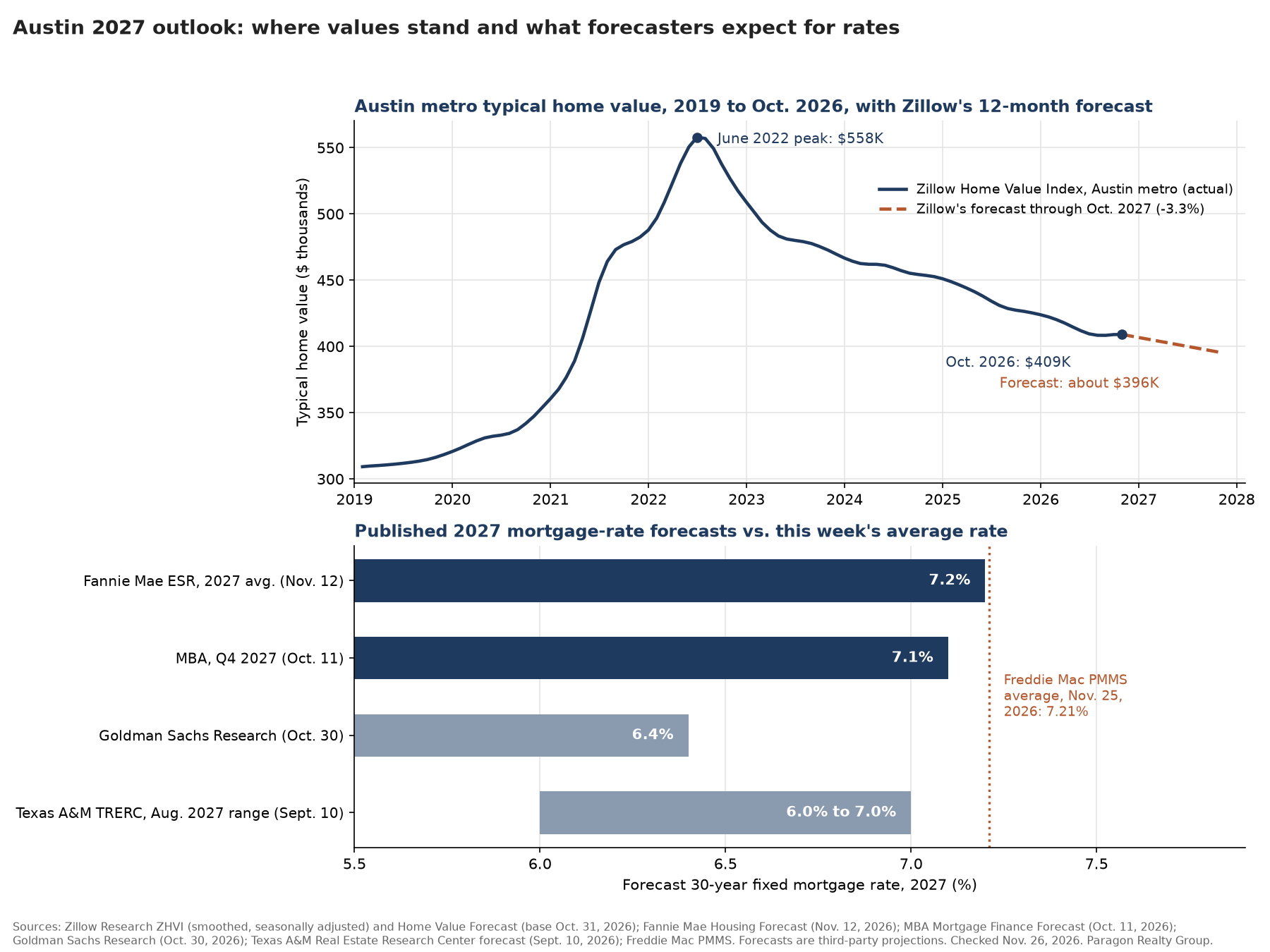
Published forecasts point to a soft 2027 in Austin: Zillow projects metro values down 3.3% through October 2027, with most 2027 rate forecasts between 6.4% and 7.2%.
By Joseph Stancil, REALTOR® since 2012, Paragon Realty Group, brokered by eXp Realty, LLC (TREC broker license #603392). Texas Sales Agent License #760204.
Paragon does not publish its own price forecast. This page collects what named forecasters expect for 2027, explains the three forces that will decide which of them is closer (resale supply, mortgage rates and builder incentives), and lays out what each rate scenario would mean for a buyer or a seller. For the month-by-month numbers behind today's market, read our October 2026 Austin market report. For listing-month timing, see our guide to choosing a listing month in Austin.
What named forecasters expect for 2027
Every figure below is a third-party projection, and each one uses a different index, geography and time window, so they are not directly comparable.
| Forecaster (date) | What it projects | Geography |
|---|---|---|
| Zillow Home Value Forecast (base date Oct. 31, 2026) | Typical home value -3.3% from Oct. 2026 to Oct. 2027; -0.6% by January 2027 | Austin metro |
| Zillow Home Value Forecast (same release) | +0.9% over the same 12 months | United States |
| Fannie Mae ESR Group (Nov. 12, 2026) | Home prices +0.6% Q4 2026 to Q4 2027; 30-year rate averaging 7.2% in 2027 and 2028 | United States |
| Mortgage Bankers Association (Oct. 11, 2026) | 30-year rate 7.2% in Q1 through Q3 2027 and 7.1% in Q4; FHFA price index +0.5% by Q4 2027 | United States |
| Goldman Sachs Research (Oct. 30, 2026) | 3.9 million existing-home sales in 2027; mortgage rates easing but "elevated at 6.4%" | United States |
| Texas A&M Real Estate Research Center (Sept. 10, 2026) | Texas median price +1.8% to $341,000 and sales +2.5% to 354,000 over the year ahead; 30-year rate of 6% to 7% in August 2027 | Texas |
Two things stand out. First, Austin sits near the bottom of Zillow's list: among the 100 largest metros, only Cape Coral, Florida, carries a weaker 12-month call. Second, the national rate forecasts cluster well above the level NAR's Lawrence Yun tied to a pickup in demand. "If somehow at the beginning of 2027 we see mortgage rates closer to 6%, we will see good buying activity at that time," he said, as Realtor.com reported in October. The MBA's Mike Fratantoni expects rates to remain above 7% through 2027, according to Realtor.com. NAR had not published a 2027 forecast when this page was written.
The starting point matters as much as the forecasts. ResiClub's November analysis of Zillow data puts the Austin metro 28.8% below its 2022 peak, one of 76 of the 300 largest markets with year-over-year declines. Fortune notes that count rose from 54 in August to 76 in October, after peaking at 89 in March.
The supply pipeline heading into 2027
Austin enters the year with a large stock of homes for sale and a shrinking flow of new ones. That combination is the main reason forecasts disagree about how much more prices can give.
Resale listings. Unlock MLS counted 13,196 active listings across the metro in October, down 2.2% from a year earlier, while new listings fell 14.3% to 3,177. Months of inventory rose to 6.2. Fewer owners are listing, but the homes already on the market are taking longer to clear. Unlock MLS ties much of the 6.9% fall in the metro median to a sales mix tilted toward cheaper homes, so part of that decline reflects what sold rather than a like-for-like price cut.
New homes. The HomesUSA.com New Home Sales Index, built from MLS data on three-month moving averages, shows Austin builders closing 709 sales in October, down from 735 in September. Austin had 6,052 active new-home listings and 896 pending, with an average new-home price of $455,885. Statewide, Texas new-home sales slipped to 5,018, a 2026 low and the fifth straight monthly decline, while pending sales were 12.8% below a year earlier.
Nationally. The Census Bureau's October new residential sales release shows 8.0 months' supply of new homes at the current sales pace and a $391,300 median new-home price. Census reports the year-to-date sales total 3.0% below 2025.
The Texas Real Estate Research Center's November Housing Insight sums up the statewide picture: major metros "including Austin, Dallas, and San Antonio, continued to experience measurable downward price pressure," and inventory "remains favorable to buyers." Its outlook adds that "unless financing conditions improve meaningfully, housing demand is likely to remain restrained."
Mortgage rates: the swing factor for 2027
The Freddie Mac Primary Mortgage Market Survey put the 30-year fixed average at 7.21% on November 25, 2026, down from 7.28% the prior week and up from 6.23% a year earlier. Almost every published 2027 forecast starts from that elevated level.
Rate direction matters more in Austin than in many metros because of how many owners bought or refinanced at low rates. Realtor.com's lock-in analysis estimates the typical Austin-Round Rock-San Marcos mortgage holder pays about $1,586 a month at a 4.0% rate, while buying a median-priced home in September 2026 would cost about $2,644, a 66.7% jump. That gap keeps would-be move-up sellers on the sidelines, which is why new listings keep falling even as prices soften.
A forecast is not a rate quote. Each borrower's rate reflects their credit profile, the loan program, any points paid and the lock date, so compare written Loan Estimates rather than headlines. For lock timing and float-down options, read our Austin rate-lock guide.
Builder incentives as a hidden price cut
In a soft market, many builders protect their list prices and spend money on the financing or closing costs instead. That makes the published median a weak guide to what a new home actually costs.
The NAHB/Wells Fargo Housing Market Index for November found that 46% of builders cut prices, the highest share of the post-Covid period, and 68% offered sales incentives, the 20th straight month above 60%. Builder confidence fell four points to 25.
For a buyer, an incentive budget can be spent three ways: a lower price, paid closing costs or a rate buydown. Each one changes the monthly payment and the long-term cost differently. Our 2-1 buydown explainer runs the same dollars through each option, and the Wolf Ranch builder incentives page tracks current Georgetown offers with links to the builders' own terms. If 2027 rates stay near 7%, as Fannie Mae and the MBA project, builders that carry heavy inventory have reason to keep these programs running. If rates fall, the need for them shrinks.
Three rate scenarios and what each means
These are planning scenarios tied to the published forecasts above, not a Paragon prediction. The point is to know in advance what you would do in each case.
| Scenario | Published anchor | For buyers | For sellers |
|---|---|---|---|
| Rates ease toward the low 6s | Goldman Sachs' 6.4%; the low end of TRERC's 6% to 7% range | More buyers return, as Yun has suggested; incentives may shrink and competition for well-priced homes could pick up | More buyers in the pool; the payment gap for move-up sellers narrows somewhat |
| Rates hold near 7% to 7.2% | Fannie Mae's 7.2% average; MBA's 7.1% to 7.2% | Leverage stays with buyers; builder incentives likely remain a key negotiating lever | Pricing from recent comparable sales and planning for longer market times remain the norm |
| Rates rise above today's level | Fannie Mae's October forecast called for 7.5% in 2027 before its November release trimmed it to 7.2%, per Scotsman Guide | Fewer competing buyers, but tighter loan qualification; payment limits matter more than list price | Fewer qualified buyers; concessions and pre-listing repairs carry more weight |
A few points hold in every scenario:
- Your timeline outranks the forecast. A job move, school calendar or lease end is a firmer reason to act than a projection that may be revised next month. Fannie Mae's 2027 rate call alone moved from 7.5% to 7.2% between its October and November releases.
- Neighborhood beats metro. The City of Austin median held flat at $550,000 in October while the five-county metro fell 6.9%, according to Unlock MLS. A single metro forecast can hide very different results by ZIP code and price tier.
- Buy the payment, not the rate story. If a payment works at today's rate, a later rate drop is an option to refinance, not a requirement. If it only works at a rate nobody is offering yet, the plan is fragile.
Planning your 2027 move
If you are buying, get pre-approved now so you know the payment limit under a 7% rate, then compare resale homes against builder inventory using each builder's written incentive terms. If you are selling, start with a pricing review against recent sales on your street, decide which concessions you would offer before you list, and use the listing-month timing guide to pick a launch window.
Joseph works with buyers and sellers across Austin, Georgetown and Williamson County. Contact Joseph to talk through which of these scenarios fits your plans and what the current numbers look like in your neighborhood.

Frequently asked questions
Will Austin home prices drop in 2027?
Some forecasters expect further softening, but none can promise it. Zillow's November release projects Austin metro home values 3.3% lower by October 2027, one of the weaker calls among large metros. National forecasts from Fannie Mae and Goldman Sachs show prices roughly flat to slightly higher across the country. Forecasts are revised monthly and use different indexes, so treat any single number as a range. Check recent sales in your specific neighborhood and price tier before acting on a metro-wide projection.
Is the Austin housing market going to crash in 2027?
None of the forecasts reviewed here describe a crash for 2027. The large correction already happened: ResiClub puts the metro about 28.8% below its 2022 peak. The 2027 projections reviewed here range from modest declines for Austin to flat national prices. A sharp further drop would likely require a shock such as a large rise in forced sales, which none of the forecasters cited above project as their base case for the coming year.
What will mortgage rates be in Austin in 2027?
Forecasts for the 30-year fixed rate mostly fall between 6.4% and 7.2%. Fannie Mae projects a 7.2% average for 2027, the MBA expects 7.1% to 7.2%, and Goldman Sachs sees rates easing to about 6.4%. Austin borrowers pay national market rates, so local forecasts follow those national calls. Your actual rate will depend on credit score, down payment, loan type and points, so compare written Loan Estimates from more than one licensed lender.
Should I wait until 2027 to buy a home in Austin?
Waiting only helps if prices fall more than your costs rise in the meantime. Rent, a possible rate change and the chance that builders scale back incentives all count against waiting. Austin buyers currently face 6.2 months of inventory and homes closing at 92.2% of list price, per Unlock MLS. If the payment fits your budget at current rates and you plan to stay several years, the forecast matters less than finding the right house and terms.
Is it a good time to sell an Austin home before 2027?
It depends on your next move more than on the forecast. Sellers face more competition and longer market times, with Unlock MLS reporting 76 days on market in October. If you need to move in 2027 anyway, a realistic list price based on recent comparable sales and a planned concession budget matter more than timing the market. Sellers who can wait and have no deadline have more flexibility to choose a spring listing window.
Joseph Stancil, TX License #760204, Paragon Realty Group, brokered by eXp Realty, LLC, TX Broker License #603392. General information, not legal, tax or financial advice; forecasts cited here are third-party projections that change frequently, and Paragon Realty Group does not make its own price predictions. Nothing here is an offer of credit or a rate quote. Sources: Zillow Research, Home Value Index and Home Value Forecast (base date October 31, 2026); Fannie Mae Economic and Strategic Research Group, Housing Forecast (November 12, 2026); Mortgage Bankers Association, Mortgage Finance Forecast (October 11, 2026); Goldman Sachs Research, "The Outlook for US Housing in 2027" (October 30, 2026); Texas A&M Real Estate Research Center, Texas Real Estate Forecast Through Summer 2027 (September 10, 2026) and Texas Housing Insight (November 20, 2026); Realtor.com News (October 21 and November 2026) and Realtor.com Economic Research lock-in analysis (November 11, 2026); ResiClub (November 18, 2026); Fortune (November 25, 2026); Scotsman Guide (November 16, 2026); Unlock MLS October 2026 Central Texas Housing Report (November 11, 2026); HomesUSA.com New Home Sales Index, October 2026 (November 13 and 24, 2026); U.S. Census Bureau, New Residential Sales, October 2026 (November 25, 2026); NAHB/Wells Fargo Housing Market Index (November 17, 2026); Freddie Mac Primary Mortgage Market Survey (November 25, 2026). All sources accessed November 26, 2026. Paragon Realty Group is not affiliated with Zillow, Fannie Mae, the MBA, Goldman Sachs, Texas A&M University, Realtor.com, ResiClub, Fortune, Scotsman Guide, Unlock MLS, HomesUSA.com, the Census Bureau, NAHB or Freddie Mac. Illustrations are AI-generated and do not show an actual home or neighborhood.

Joseph Stancil
Founder & Supervising Agent | Paragon Realty Group
Joseph Stancil, first licensed in real estate in 2012 and in Texas since 2021, writes every article in The Paragon Chronicle. His market analysis draws on proprietary data, direct transaction experience, and deep relationships throughout Austin's luxury communities.